How to Package a Chargeback Response: A Collection Agency Guide

TABLE OF CONTENTS
A chargeback response has one reader, and that reader is in a hurry. They work at the cardholder’s bank, they have a queue of disputes to get through, and they’ve never heard of your agency. Whatever you send has to make sense to them in a couple of minutes.
At Midigator, a company acquired with Equifax, I read more chargeback responses than I’d like to admit. The responses that held up answered the reviewer’s question and made the proof easy to find.
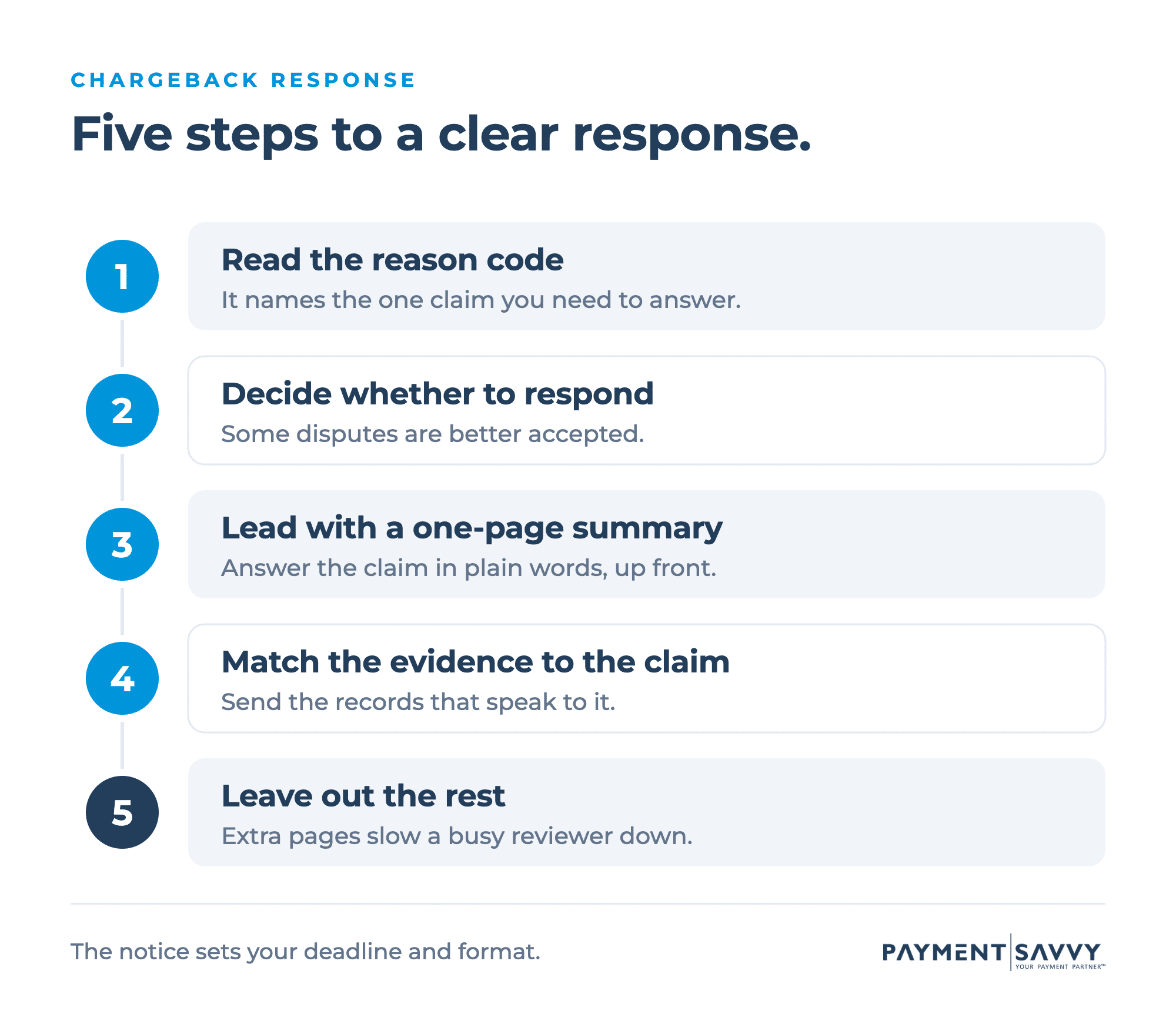
For a collection agency, that takes a little translating. Most of the advice out there speaks to online stores. There’s no tracking number or delivery photo for a payment on an account. So here’s how I’d package a chargeback response when the notice lands, in five steps.
One note before we start: the card networks update their rules, so check the current version before you rely on a detail here. Treat this as a guide to the thinking, not a ruling on any one dispute.
Start with the reason code
Every dispute arrives with a reason code, and the code tells you what the cardholder told their bank. Visa sorts disputes into four groups: fraud, authorization, processing errors and consumer disputes. Mastercard’s Chargebacks Made Simple guide lists four that line up closely. A fraud code says “I didn’t make this payment.” A consumer dispute code says something different, such as “I cancelled this” or “You owe me a credit.”
The response only has to answer that one claim. Proof that the consumer owes the balance doesn’t answer “I didn’t authorize this payment.” A signed authorization doesn’t answer a duplicate charge. Read the code first, and let it decide what goes in the package.
Check the date on the notice while you’re there. The amount in dispute typically comes out of your account when the bank opens the case. The notice states how long you have to respond, and that window varies by processor.
Decide whether to respond
Not every dispute is worth contesting, and Visa says so directly. Its merchant guidelines note that some disputes can’t be remedied, and that accepting one “may save you the time and expense of needlessly contesting it.”
Sometimes the consumer is right. If a payment ran twice, or a consumer withdrew permission for recurring payments and never received a refund, the guidelines point to accepting the dispute. When you’ve already processed a refund, the response is the record of that credit with its amount and date. You don’t need anything else.
Contest the dispute when your records support a response to the specific claim and meet the applicable network requirements. Here’s how I’d organize that response.
Lead with a one-page summary
Put a short cover page on top. In my experience it’s the most useful page in the package, because it tells the reviewer what they’re about to see.
The cover page needs the case number, the payment date and amount, and the reason code. Then add one or two sentences that answer the claim in plain words. For example: the cardholder authorized this payment by phone on March 3 as the fourth installment of a payment arrangement. We emailed a receipt the same day. Finish with a short list of the documents that follow and what each one shows. If your processor gives you a form or a portal field for the response, the same content goes there.
Keep the tone plain and factual. The reviewer isn’t judging the debt or the consumer, only whether the payment was valid under the network’s rules.
Match the evidence to the claim
A collections chargeback response differs most from a retail one right here. It helps to walk through the records that speak to each claim.
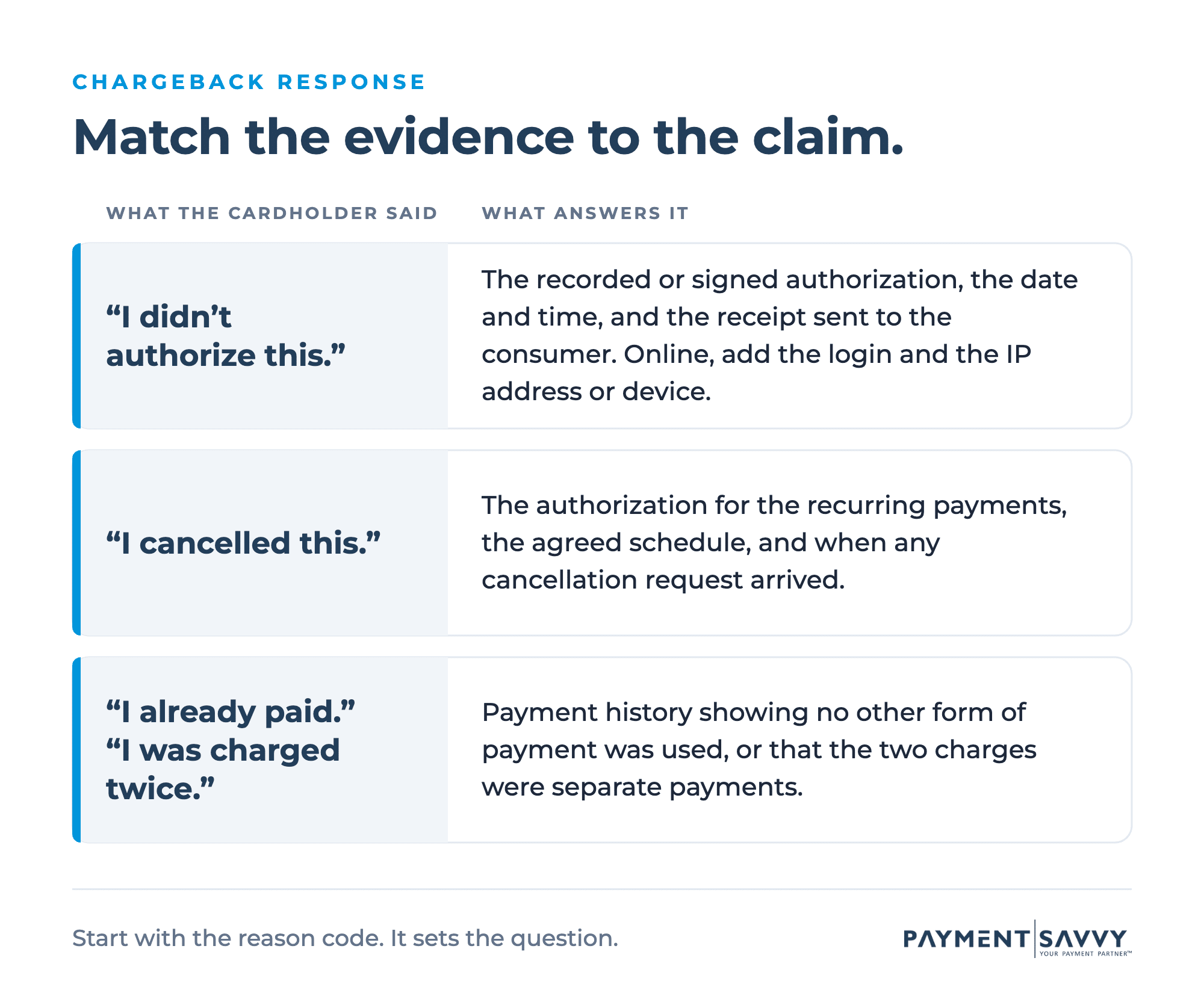
When the claim is “I didn’t authorize this,” the job is to show the cardholder took part in the payment. Visa calls this compelling evidence. For a phone payment, that’s the recorded authorization or the signed form, plus the date and time. Add the confirmation that went to the consumer’s email or phone afterward. For a payment made online, it’s the login, the IP address or device, the timestamp and the receipt.
For an “I cancelled this” claim, timing decides it. Show the authorization for the recurring payments, the schedule the consumer agreed to, and your record of when any cancellation request arrived compared with when the payment ran.
For “I already paid” or “I was charged twice,” the answer sits in your payment history. Visa asks for records showing the consumer used no other form of payment, or showing that two charges were separate payments. An account ledger with dates and amounts does that well.
Whatever you include, make it readable. Visa’s guidelines ask that evidence be legible and in English, or come with an English translation. Label each document and highlight the line that matters, because a screenshot nobody can read helps no one.
What earlier payments can show
Payment arrangements can provide useful evidence: earlier transactions that help connect the cardholder to the disputed payment. For eligible Visa fraud disputes under condition 10.4, Compelling Evidence 3.0 uses two qualifying earlier transactions on the same payment credential, with specified matching data. Under the criteria applicable through October 23, 2026, those transactions must also be with the same merchant.
Say a consumer disputes installment nine after months of portal payments from the same device and login. That history may help, but matching data alone is not enough. The earlier payments must also meet Visa’s transaction-age and fraud-reporting requirements. Visa’s published April 2026 rules expand this remedy for disputes processed on or after October 24, 2026. Confirm eligibility and submission requirements with your processor. We’ll explore CE3.0 in more detail in an upcoming post.
What to leave out of a chargeback response
More isn’t better here. Leave out the full account history when two lines of it make the point. Leave out internal notes that characterize the consumer, and anything about the underlying debt that the reason code doesn’t ask about. Extra pages slow a busy reviewer down, and extra personal information shouldn’t travel further than it needs to.
A chargeback response starts before the dispute
A strong chargeback response starts with the records you create when a consumer pays. Clear authorization, a specific receipt, and accessible payment history give your team something to work from when a dispute arrives. A recognizable name on the consumer’s statement may help prevent one in the first place. We covered that side of the process in Chargebacks in Collections.
Payment Savvy has focused on payment processing for collection agencies since 2011. If you’d like to talk through how your payment setup captures authorizations, delivers receipts, and keeps payment records accessible, contact our team.
A completed payment is the finish line. When a consumer disputes one, a clear, well-packaged chargeback response is how you defend it.
PAYMENT SOLUTIONS
FEATURED INDUSTRIES