Switching Payment Providers? Six Questions for Collection Agencies

TABLE OF CONTENTS
Switching payment providers is one of those decisions that’s easy to put off. Even when you’re ready for better service or clearer reporting, the current setup works well enough, your team knows it, and nobody wants to be the reason payments got interrupted.
I get that. For a collection agency, a change like this touches your collection software, your team and the consumers who are already paying you, so it makes sense to want a clear picture before you commit to anything.
Most of that picture can come from one good conversation. An experienced partner should be able to walk you through what a move would involve, which parts of your setup can stay in place, and what needs attention. The quality of that conversation can tell you quite a bit about the relationship you’re considering.
Here are six questions I’d bring to it.
1. Do you already integrate with our collection software?
Start with the system your team uses every day. Ask whether the integration is live, what it supports, and whether the provider has experience working with agencies using it. Get specific about recurring payments, account updates, and reporting. An existing connection is valuable when it supports the work your agency actually needs to do.
It’s also worth asking how the payment provider and software company work together. Who handles questions about the connection? Who gets involved if something needs to be adjusted? A partner that knows your software and the people supporting it has useful context before the transition even begins.
2. What would actually need to change in our setup?
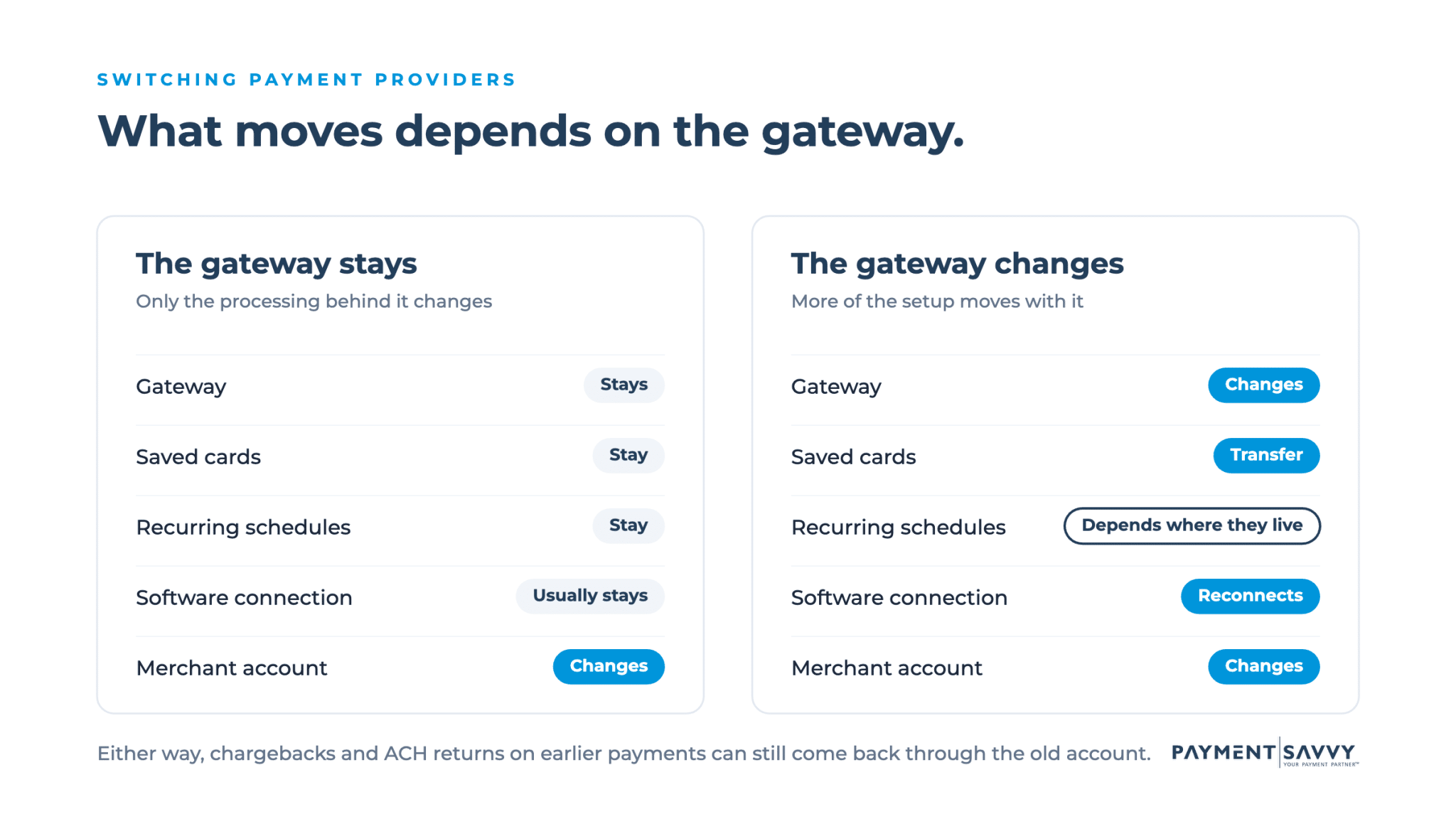
“Switching payment providers” can mean different things. Depending on your setup, the gateway and the system holding saved payment information may stay in place. In another situation, those pieces may change along with the processing relationship. That difference affects the scope of the move, and your prospective partner should ask enough questions to explain which situation applies to you.
I’d expect a clear walkthrough: here’s what you have today, here’s what would change, and here’s what that means for your team. If something needs confirmation from your current provider or software company, that should be identified early.
3. What happens to our saved payment information and active schedules?
This is the question behind much of the hesitation about switching. Saved card or bank account information and recurring schedules may live in different systems. Keeping an arrangement running means accounting for both, along with the consumer’s authorization.
It helps to know how saved cards are usually stored. Most systems keep a token, a stand-in value that only works with the system that issued it. If the gateway stays in place, the tokens generally stay with it. If the gateway changes, the card details have to be moved through a secure, supported transfer between the two companies, which is why the answer to the last question matters so much here.
Ask what can remain where it is, what can be transferred, and whether any consumers would need to take action. Have your prospective partner explain how the next payment date, amount, and remaining installments will be preserved. For example, a consumer seven payments into a twelve-payment arrangement should have a clear path for the remaining five.
There may be more than one workable approach. Where supported, some agencies move existing arrangements, while others let those plans finish on the current setup and start new arrangements with the new provider. Your partner should help you weigh the options based on your business, including the work and costs involved.
4. Who will coordinate the move, and what will you need from us?
Agency owners and operations leaders already have full schedules, so it’s reasonable to want a clear picture of the time and people a transition will require. Ask who your main contact will be, who coordinates with your software company, and where your current provider needs to participate. Then ask what your agency needs to supply and who on your team should be involved. The answers should be specific enough to plan around: documents, decisions, testing, and any communication with consumers.
This is also a useful way to evaluate service before becoming a client. Notice whether the prospective partner explains responsibilities clearly, follows up on unanswered questions, and helps move the conversation forward.
5. How will we know everything is working after the switch?
Agree on what a successful transition looks like before choosing a launch date. That includes confirming the right payment methods are connected to the right accounts, upcoming payments are scheduled correctly, and payment results appear where your team expects them.
Ask how payments due around the changeover will be handled and who will review the first scheduled payments afterward. You don’t need to design the testing process yourself. You do need a partner who can explain it and tell you how any exceptions will be resolved.
Payments made before the move need a plan too. If a consumer disputes an earlier card payment, the chargeback comes back through the account that processed it, and card dispute windows can run for months. ACH works the same way. Under the Nacha Rules, a consumer’s bank can return an unauthorized debit up to 60 days after it settled. That usually means keeping your current account open for a while after the switch, with someone watching it, and making sure your team can still reach earlier transaction records.
One more detail from my time on the dispute side. If the name consumers see on their card or bank statement changes, a payment they agreed to can suddenly look unfamiliar, and an unfamiliar charge is an easy one to dispute. Ask what the new statement name will be, and make sure consumers will recognize it.
6. Who will support us after we’re up and running?
A transition is the beginning of the relationship. Your team will still have questions about reports, payment results, and how the setup fits your daily work. Ask how you reach support, how issues with your collection software get coordinated, and who follows a question through to an answer.
Collections experience matters in those conversations. A partner familiar with the industry understands why an account update, a recurring installment, or a reporting question can affect several people across your agency. You should feel confident that the people supporting your payments understand the business behind them.
Where Payment Savvy fits
Payment Savvy has been in payments since 2011. Over that time, we’ve built relationships across the collections industry and a broad network of integrated software partners. That history matters because a payment transition brings together technology, daily operations, and people who need to work well together.
If you’re considering a change, bring us your questions. Let’s talk through your current setup and what a move to Payment Savvy would involve.
A payment partner worth switching to will have good answers to all six. The best ones will be glad you asked.
PAYMENT SOLUTIONS
FEATURED INDUSTRIES