That $3.95 Fee: Surcharge or Convenience Fee?

TABLE OF CONTENTS
A consumer is looking at a receipt. Their balance was $210.00, but the card was charged $213.95. So they call and ask a reasonable question: what is the extra $3.95?
One agency might call it a convenience fee. Another might call it a surcharge. Sometimes the words get used as though they’re interchangeable.
They aren’t.
A surcharge and a convenience fee exist for different reasons, follow different card-network rules, and behave differently in the payment flow. In collections there’s another layer: before worrying about what a fee is called, a debt collector has to consider whether collecting that additional amount is authorized at all.
Quick note before we get into it. This is an educational explanation of published card-network rules and federal law. It isn’t legal or compliance advice, and it isn’t a determination that any particular agency may charge either type of fee. Your program, your underlying agreements, your states, your clients, your acquirer, and your payment flow all matter.
The simplest distinction: card or channel?
The cleanest way to separate the two is to ask why the fee is being charged.
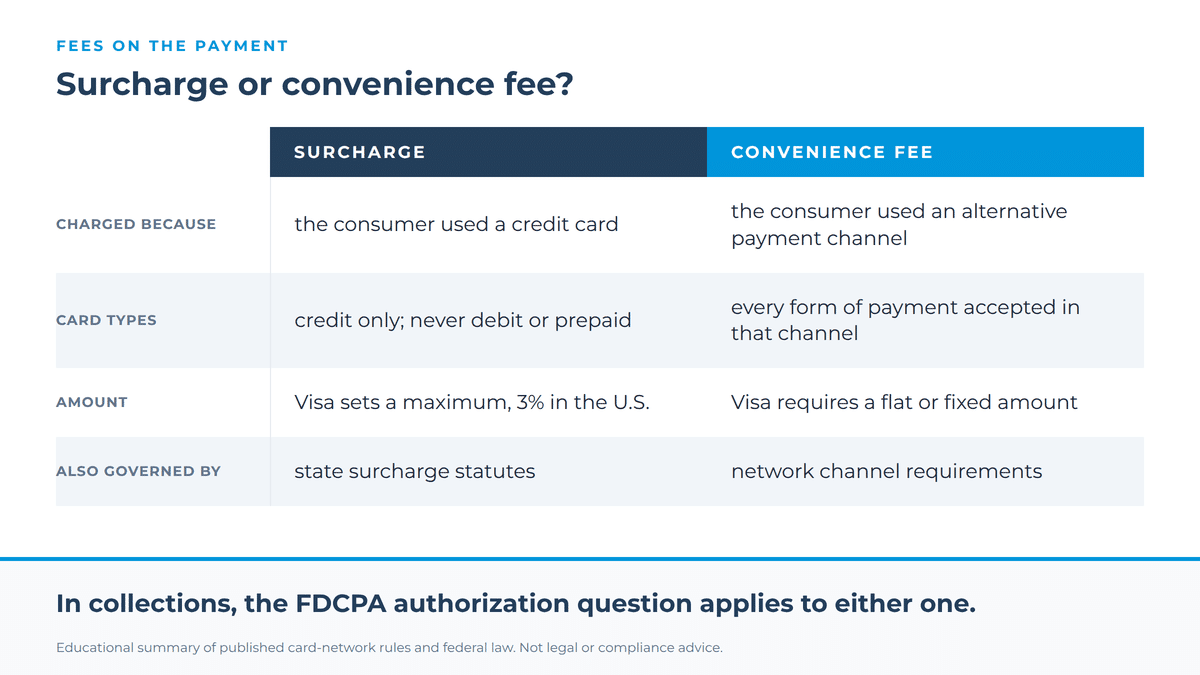
A surcharge is tied to the consumer’s decision to pay with a credit card. Use a different payment method and the surcharge doesn’t apply.
A convenience fee, under Visa’s U.S. rules, is tied to a bona fide convenience in the form of an alternative payment channel outside the merchant’s customary payment channels. Picture a merchant whose customary channel is mail, offering online or telephone payment as an alternative. The fee exists because the consumer chose that channel, not because they used a card.
That’s a more reliable test than the shortcut we hear constantly: a surcharge is a percentage, a convenience fee is flat. The second half is right. Visa requires a convenience fee to be a flat or fixed amount regardless of the payment amount. The first half is looser than it sounds. Visa sets a maximum for the credit-card surcharge rather than prescribing how the amount is structured, and Mastercard’s public materials generally describe surcharging in percentage terms. The math is a clue. It isn’t the definition.
Start with the reason for the fee.
A surcharge is tied to credit-card use
Under Visa’s U.S. rules, a merchant may assess a credit-card surcharge, subject to applicable law and the network’s requirements. Visa’s maximum in the U.S. is 3%, and the surcharge also can’t exceed the merchant’s applicable cost-of-acceptance cap. Mastercard takes the same approach on card type and caps the surcharge at the merchant’s cost of acceptance, with a published maximum of 4%.
Card type is where this gets consequential. Visa’s merchant guidance is direct: debit cards and prepaid cards cannot be surcharged. Mastercard permits surcharging on its credit cards and prohibits it on debit. Which means a surcharge program has to identify what kind of card it’s looking at before it can calculate anything.
Surcharging also isn’t something a merchant turns on at checkout. Both networks require advance notice, to the acquirer and in Mastercard’s case to Mastercard as well, along with consumer disclosures at the point of entry and on the receipt.
Then state law gets a vote. States impose their own limits and disclosure requirements, and those laws change. Colorado, for example, permits a credit-card surcharge but caps it at either 2% of the transaction or the merchant discount fee depending on the method used, prohibits it on debit-card payments, and prescribes specific consumer disclosures. This is why we wouldn’t lean on any blog’s static list of states that prohibit surcharging, including ours. Network rules are one part of the picture. State requirements have to be checked where the business actually operates.
A convenience fee is tied to an alternative payment channel
A convenience fee starts from a different premise. Visa’s U.S. rules say it must be charged for a bona fide convenience in the form of an alternative payment channel outside the merchant’s customary channels. It can’t simply be a fee for accepting a card.
That premise drives the mechanics. Under Visa’s rule the fee must be flat or fixed, disclosed clearly before the transaction is completed with an opportunity for the consumer to cancel, applied to all forms of payment the merchant accepts in that alternative channel, and included in the total transaction rather than collected separately. It also can’t be charged on top of a surcharge.
Those are the requirements that get summarized most often. Visa’s rule includes others that turn on how a specific merchant, channel, and transaction type are set up, which is exactly why a fee program is worth reviewing against the current rule text rather than against a summary of it.
Mastercard’s rules aren’t a copy of Visa’s. They permit fees like convenience fees when imposed on like transactions regardless of the form of payment used, and separately provide that a merchant can’t surcharge a Mastercard credit transaction that already carries a permitted convenience or service fee. For an agency accepting multiple brands, the program has to work across all the rules that actually apply.
So can a collection agency charge a surcharge?
Here the answer matters more than the label.
The card networks publish the circumstances under which merchants may surcharge credit cards. Those rules don’t answer whether a debt collector may collect that amount from a consumer. The Fair Debt Collection Practices Act does. Section 808 prohibits:
The collection of any amount (including any interest, fee, charge, or expense incidental to the principal obligation) unless such amount is expressly authorized by the agreement creating the debt or permitted by law.
Regulation F carries the same rule. That language is why I’d be careful with any suggestion that a surcharge sits outside the collections analysis.
Courts have looked at percentage-based card fees in this context before. In Wittman v. CB1, a federal district court in Montana considered a 2.5% fee the collector described as a surcharge, charged on both debit and credit-card payments, and concluded it fell within the scope of 1692f(1) as incidental to the principal obligation. That case later settled without any admission of wrongdoing, and the fee at issue wouldn’t have qualified as a network-compliant surcharge anyway, since it was applied to debit. But it makes the point: calling something a surcharge doesn’t, by itself, remove the FDCPA question.
So if the question is “can collection agencies surcharge,” the honest answer isn’t a simple yes. The better question is whether a particular agency’s fee satisfies the applicable card-network and state requirements, and whether collecting that additional amount is authorized under the agreements and laws governing the debt. That’s work for compliance counsel, your clients, and your acquiring partners, before anything gets turned on.
Why convenience fees get more attention
If 1692f(1) isn’t limited to convenience fees, why does so much of the conversation in collections center on them? Because that’s where the published history developed.
In 2022 the CFPB issued an advisory opinion addressing pay-to-pay fees, also called convenience fees, taking the position that debt collectors couldn’t charge them unless the fees were expressly authorized by the agreement creating the debt or affirmatively permitted by law. The Bureau withdrew that opinion on May 12, 2025. The withdrawal removed the guidance. It didn’t remove 1692f(1) from the FDCPA or the corresponding language from Regulation F.
Courts have kept going. In 2025 the Eleventh Circuit held in Glover v. Ocwen Loan Servicing that a servicer violated 1692f(1) by charging optional online and telephone payment fees that were neither expressly authorized by the agreements nor permitted by law. The Fourth Circuit read “any amount” the same expansive way in Alexander v. Carrington Mortgage Services, applying the FDCPA standard incorporated into Maryland’s debt collection statute.
So convenience fees have the more developed record. That isn’t the same as saying the FDCPA only cares about convenience fees. It cares about the collection of any additional amount.
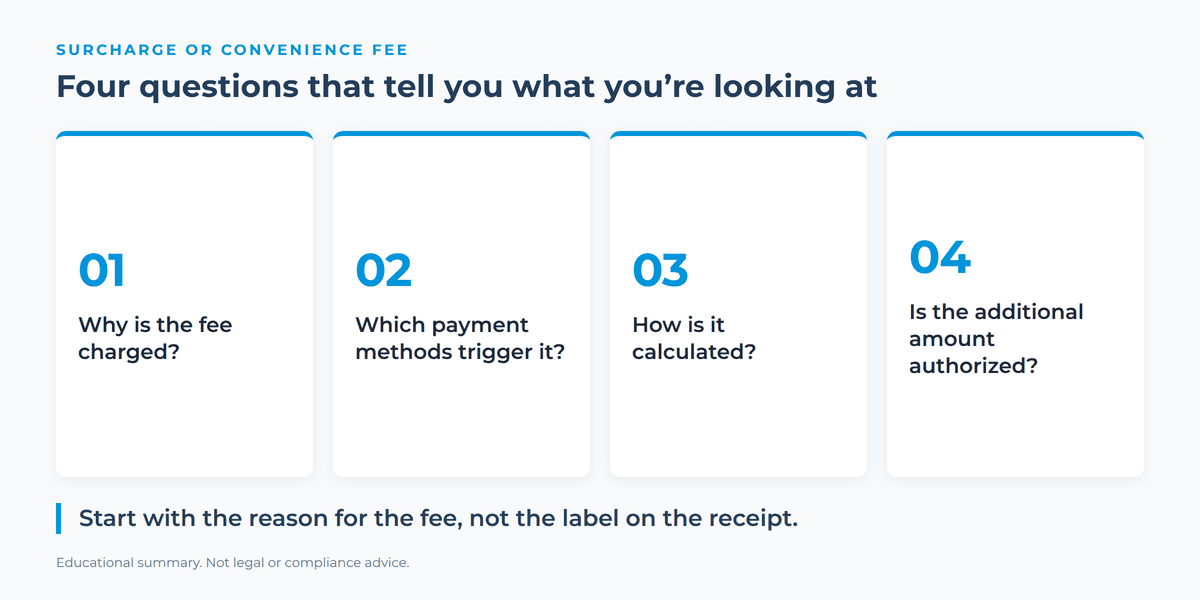
Four questions that tell you what you’re looking at
I wouldn’t start with what the receipt calls it. I’d start here.
Why is the fee being charged? Because the consumer chose a credit card, or because they chose an alternative payment channel?
Which payment methods trigger it? A surcharge is limited to qualifying credit-card transactions. Under Visa’s rule, a convenience fee applies to all forms of payment accepted in that alternative channel.
How is it calculated? Visa requires a convenience fee to be flat or fixed. A surcharge may be structured differently, so don’t treat percentage-versus-flat as the definition.
And if this is debt collection, is the additional amount authorized? Card-network compliance doesn’t replace the FDCPA, state law, or the agreement creating the debt.
The bottom line
A surcharge and a convenience fee look nearly identical to a consumer. Both show up as a few extra dollars attached to a payment. That’s where the resemblance ends.
A surcharge is tied to the use of a credit card and lives under network surcharge rules, caps, disclosures, and state law. A convenience fee is tied to a bona fide alternative payment channel and lives under a different set of network requirements. In collections, neither label answers the whole question, because the authorization question under the FDCPA has to be worked through on its own.
That’s why getting the fee right isn’t semantics. It’s part of getting the payment right.
If you’re working with a convenience fee program and want to go deeper on setup, our guide to convenience fees for collection agencies picks up from here, and our guide to payment authorization compliance covers the documentation side.
This article is educational and describes published card-network rules and federal law as of September 2026. It is not legal or compliance advice and does not determine whether any specific fee, contract, state, merchant, or collection agency satisfies applicable requirements. Consult qualified compliance counsel and your acquiring and payment partners before establishing or changing a fee program.
PAYMENT SOLUTIONS
FEATURED INDUSTRIES