Visa and Mastercard Interchange Settlement: What the Terms Say

TABLE OF CONTENTS
If you saw the Visa and Mastercard settlement headlines in June and came away thinking merchants were about to split a $38 billion payout, or that card acceptance costs were about to drop overnight, you weren’t alone. Neither is quite what happened.
The $38 billion isn’t a settlement fund. It’s an estimate from court-appointed economists of what merchants could collectively save on interchange over five years if the settlement takes effect as written. There’s no pool of money behind it and no claim to file.
What happened on June 9 was preliminary approval. Judge Brian Cogan, in the Eastern District of New York, cleared a proposed settlement to go out to the merchant class for notice and comment. It would change certain Visa and Mastercard interchange rates and merchant acceptance rules going forward, and final approval hasn’t happened yet.
So before we get into what this could mean for merchants, collection agencies, and other higher-risk businesses, it’s worth separating the headline from the actual terms.
One note before we start: this is an educational overview, not legal or compliance guidance. How any provision applies to a particular business should be reviewed with your own counsel and advisors.
First, there are two different Visa and Mastercard settlements
These get mixed together constantly, and it’s the easiest part of the story to lose track of.
The earlier settlement dealt with money for past conduct. It created a $5.54 billion damages fund for eligible merchants that accepted Visa or Mastercard during the applicable class period, it had a claims process, and its February 2025 filing deadline has passed. Distributions are underway now.
The 2026 settlement is a separate settlement focused on forward-looking relief. There’s no payout fund and no claim form, because this one is about what happens going forward. If it receives final approval, it would change certain interchange rates and network rules governing how merchants accept and steer card payments.
One paid claims for the past. The other would change rules for the future. If you’re seeing something that tells you to submit a claim for the new $38 billion settlement, those two cases are being mixed together.
What would change about Visa and Mastercard interchange
There are two rate provisions in the proposed settlement.
The first would reduce the U.S. combined average effective credit interchange rate by 10 basis points, or 0.10%, for five years, and hold posted interchange rates at their March 31, 2025 levels over that same period. That first phrase is worth reading closely. It describes a blended average across an entire rate structure, which means individual categories can still move differently within it.
The second would cap interchange on certain standard consumer credit cards at 1.25% for eight years. That cap covers defined standard consumer products, including Visa Traditional and Traditional Rewards and Mastercard Core and Enhanced Value cards. Premium consumer and commercial cards aren’t included in it.
That distinction matters, because interchange isn’t one universal rate. Card type, rewards level, and transaction characteristics all affect what applies.
There’s a second distinction worth just as much attention. Interchange isn’t the total cost of accepting a card. It’s the portion of a card transaction that goes to the issuing bank. Network assessments sit alongside it, and so do the costs tied to processing, authorization, settlement, gateway technology, service, underwriting, and risk. Those can look very different from one business to another, particularly in higher-risk industries.
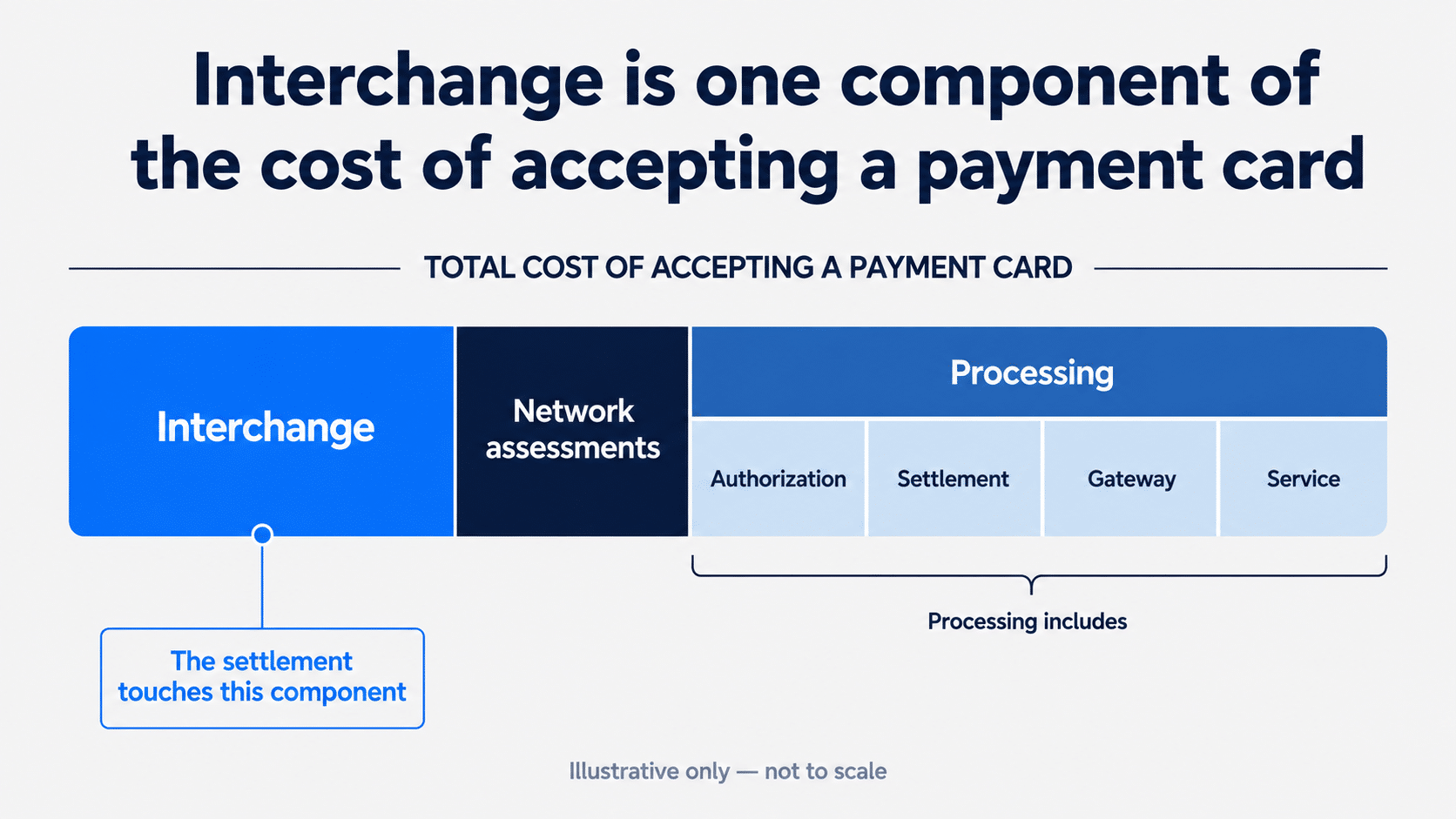
So the settlement could change an important component of card acceptance costs. The 1.25% figure still isn’t the total cost of processing a card transaction, and it shouldn’t be read as one.
Merchants could also get more control over which cards they accept
The rule changes may end up mattering more than the rate changes.
Under the proposed settlement, merchants could choose whether to accept certain categories of Visa and Mastercard credit cards, including standard consumer, premium consumer, and commercial cards. Today, the honor-all-cards structure generally limits that flexibility.
There’s a limit to the new flexibility too. A merchant could decline a category after providing the required notice to its acquirer, but the choice happens at the category level, not card by card. If you accept a category, you still have to accept every card within it.
On paper, that creates an opportunity to avoid some higher-cost card products. Operationally, the decision gets more complicated.
For a collection agency, the payment moment is the finish line of everything that came before it. Outreach worked. The consumer engaged. An arrangement was made. Someone is finally ready to pay. Declining the card they pull out at that exact moment carries a cost of its own, and that cost never appears as a line item on a processing statement.
The same consideration applies to other higher-risk merchants where payment completion carries real operational value. Lower acceptance cost matters. So does whether the payment gets completed at all.
None of that means declining a card category would always be the wrong call. For some businesses the math may support it. It does mean the math should include more than interchange.
The settlement also changes surcharging rules
The proposed settlement would expand merchants’ ability to surcharge eligible Visa and Mastercard credit card transactions. Merchants could surcharge at either the brand level or the product level, though not both at the same time, and the surcharge would generally be limited to the lesser of 3% of the transaction amount or the merchant’s applicable cost of acceptance.
One clarification that matters here: a surcharge is not the same thing as a convenience fee. They serve different purposes and carry different card-network requirements, so the two terms shouldn’t be used interchangeably. That difference deserves its own article, and we’ll give it one soon.
For this settlement, the point is narrower. Visa and Mastercard would give merchants additional network-level flexibility around surcharging.
Network permission is only one part of the analysis, though. State law may impose separate requirements or limitations, and particular industries can carry rules of their own. In collections, whether a fee may be charged to a consumer can also involve the FDCPA, applicable state law, and the agreement that created the debt.
A card network saying how something may be done doesn’t answer whether a particular business may do it.
None of this changes tomorrow
This might be the most important part of the whole story.
These provisions aren’t in effect today. The court granted preliminary approval in June, merchants still have an opportunity to object, and a decision on final approval comes after that. Walmart has already objected through counsel, and the National Association of Convenience Stores has said it will appeal to the Second Circuit if final approval is granted.
It’s also worth knowing that a different, earlier version of this settlement was denied preliminary approval back in 2024. The outcome here hasn’t felt inevitable at any point.
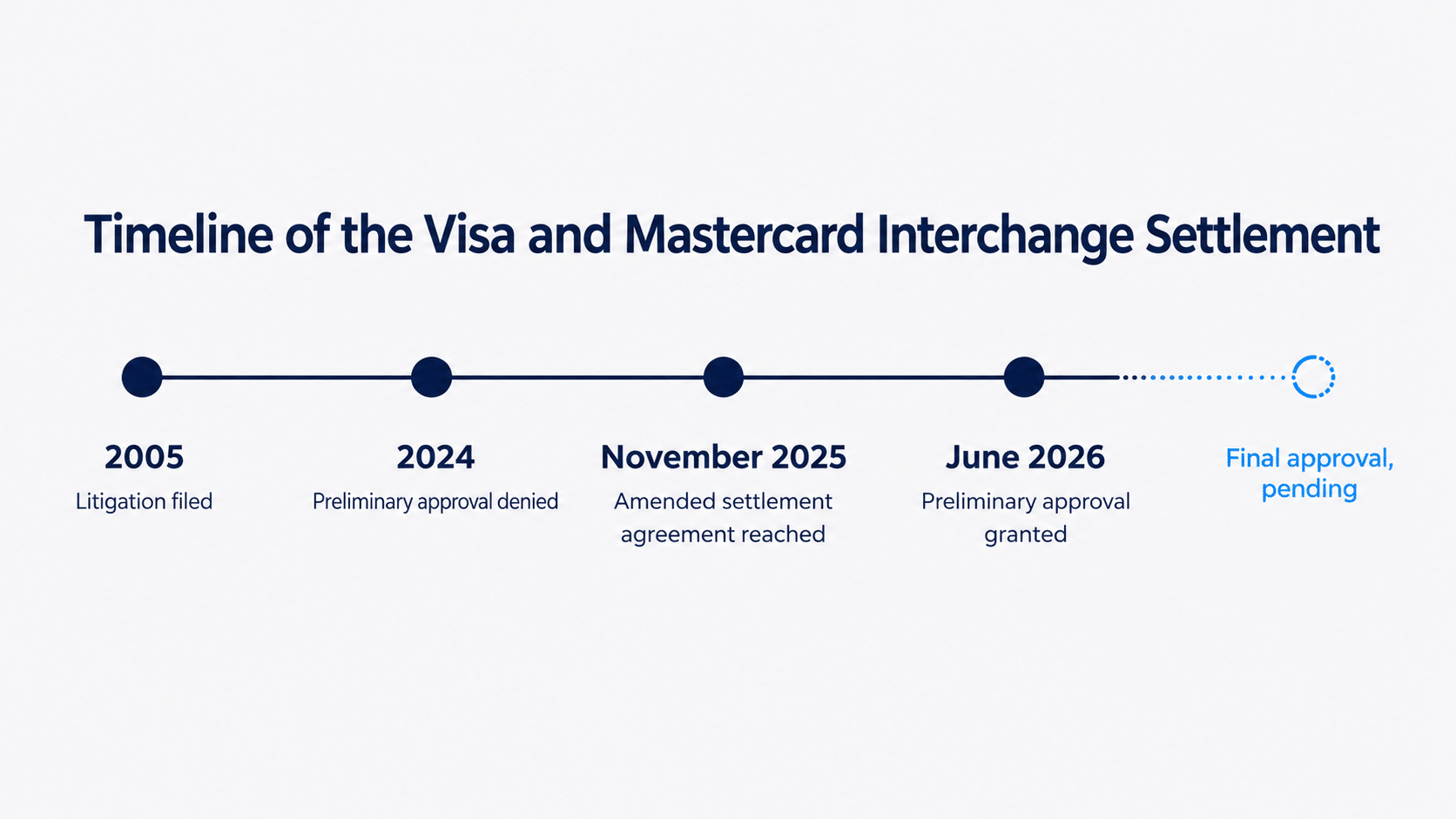
Even if the settlement clears final approval, implementation doesn’t happen with the flip of a switch. The interchange changes are tied to the networks’ regular rate-update cycles. The acceptance and surcharging changes need network, acquirer, processor, gateway, and payment-system infrastructure to support them first. Analysts following the case expect a final decision late this year or early next, with appeals potentially stretching implementation well beyond that.
So the headline arrived a long way ahead of the practical effect.
What’s worth looking at now
You don’t need to predict what the court will do to start understanding how these provisions could affect your business.
What does your card mix actually look like?
The settlement treats standard consumer, premium consumer, and commercial cards differently. Knowing how much of your current volume falls into each category gives you a far better starting point than the headline numbers do.
What would declining a payment cost you?
If a card category becomes optional, don’t evaluate the decision on interchange alone. Look at what happens when that card gets declined. Does the consumer have another payment method ready? Do they try again? Does an agent have to get involved? Does the payment disappear altogether?
The cheapest transaction isn’t always the best outcome.
Which provisions would meaningfully change what you do today?
Some businesses may find the rate provisions most relevant. Others will care far more about acceptance flexibility. And some may find the new options don’t change their current payment strategy much at all. That’s the argument for starting with your own operation rather than with the headline.
Where this goes from here
The next milestone is the objection period and the court’s decision on final approval, with further legal challenges possible after that. Until that plays out, this is a proposed framework rather than a new operating rule.
It’s still worth watching. Interchange rates may change, but the more interesting part is that merchants could get new choices about which cards they accept and how they steer payment behavior.
For collection agencies and other businesses where the payment moment carries outsized value, those choices deserve a wider calculation than cost per transaction alone. That’s the part we’ll be watching most closely.
If you’d like this kind of practical read on payment changes as they happen, our Monthly Rewind is where we send it.
PAYMENT SOLUTIONS
FEATURED INDUSTRIES