AI Terms for Collections: A Plain-English Glossary

TABLE OF CONTENTS
I’ve been going through the Brainstorm agenda, deciding which sessions to catch in Denver. I started to notice the same thing kept happening while I read. A word I’d seen plenty of times would go by, and I’d catch myself unable to define it cleanly if anyone asked me to.
Agentic. Guardrails. Open-weight. Synthetic data.
The language around AI is moving almost as fast as the technology. Some of these terms are straightforward. Others get used differently depending on who’s talking, what they’re building, or what they’re trying to sell, which is where it gets slippery for anyone trying to make a decision.
So I started keeping notes. Not textbook definitions, but what these words mean in a real conversation about collections, compliance, and data. Ten terms, each with a question worth having on deck. The kind you could ask a panelist, a peer at your table, or whoever you end up sitting next to at any industry event this year.
What it is
Model / LLM
Almost nothing you get shown at a conference is a model. It’s a product with a model inside it, the way your CRM is a product with a database inside it.
The model is the underlying system doing the reasoning. An LLM, or large language model, is the type built to work with language, and GPT, Claude, Gemini, and Llama are all examples. Everything wrapped around the model is the interface, the workflows, the integrations, the rules, the reporting, and the security controls, often built by an entirely different company.
None of that makes a product less valuable. Most of the good ones are built exactly this way. But it does mean you’re evaluating two things at once, and only one of them is under your vendor’s control.
Question to have on deck: when you picked your tool, how much did the model underneath matter to the decision?
Open-weight
An open-weight model publishes its learned parameters, so the model can be downloaded and run in an environment you control rather than only reached through someone else’s service. That opens real options for anyone who has ever had a hard conversation about where consumer data goes.
The term is also easy to over-read. Open-weight does not automatically mean private, secure, or fully open-source. How the model is hosted, what connects to it, what it can reach, and how the surrounding system is configured all still matter, and any one of them can undo the advantage.
I got curious about open-weight models reading a session description on building an offline chatbot, which is the version of the idea most people never encounter.
Question to have on deck: has anyone here run a model in their own environment, and was it worth the setup?
What it does
Prompt / prompting
A prompt is what you give the model to work with. Sometimes a prompt is just a question. More often, when it’s working well, it’s instructions plus examples plus a document or two, along with enough background that the model can tell what a good answer would even look like.
Prompting is the term I’d have most undersold a year ago. “Write an email” and “write a short follow-up to an operations leader who already knows us, keep it warm and direct and under 100 words” are technically the same request. They don’t produce remotely the same answer, and the gap between them accounts for a great deal of what people mean when they say a tool did or didn’t work for them.
Question to have deck: how much of your early trouble turned out to be the tool, and how much was how you were asking?
Agent / agentic
Agentic covers a lot of ground right now, everything from tools that draft to systems that act. The distinction underneath is simple. A tool produces something for you to review. An agent goes on to act.
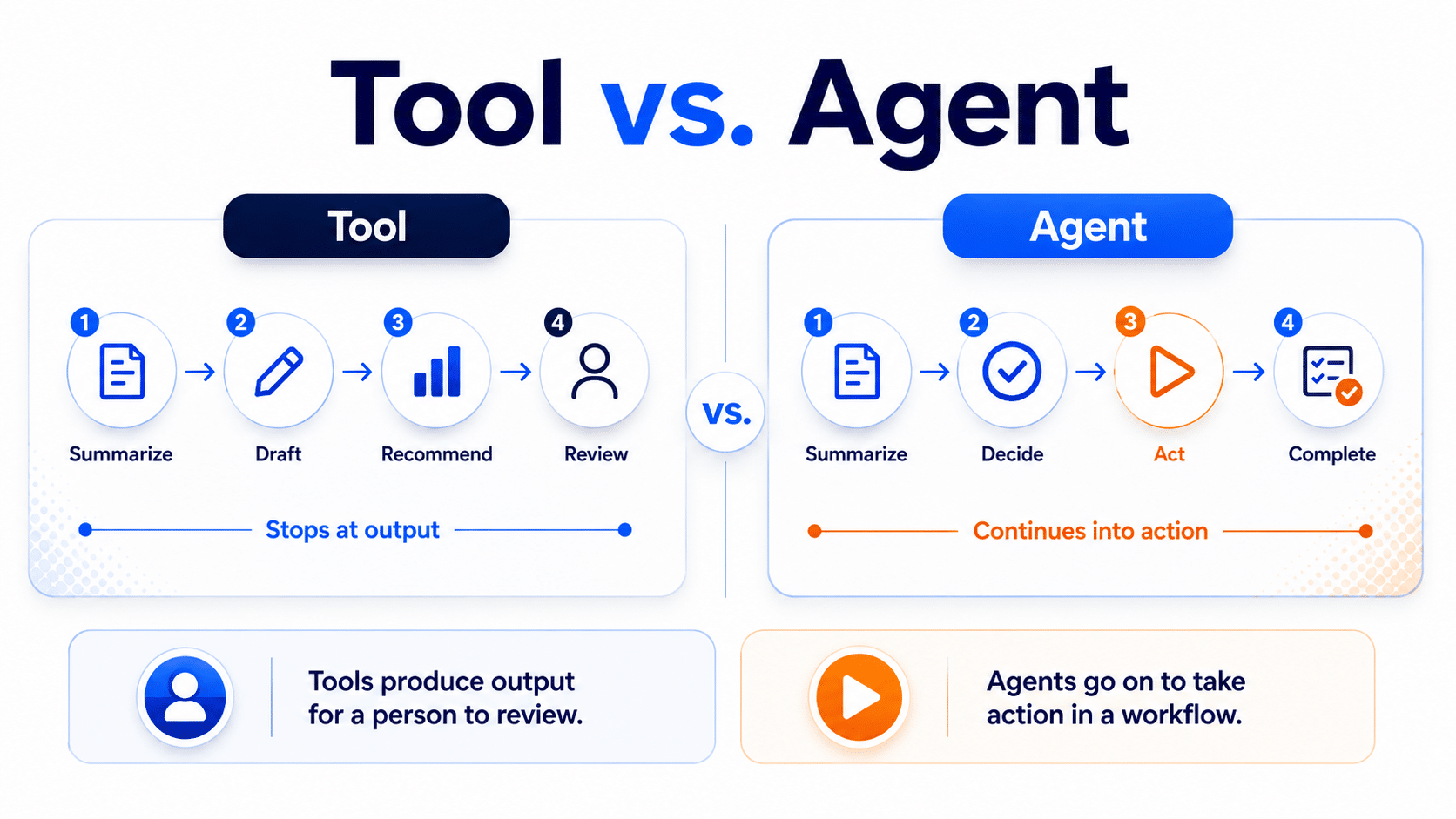
A tool summarizes an account, drafts a message, flags a pattern, recommends a next step. An agent moves past the recommendation and does the thing, inside a workflow someone defined. That difference lands harder in our industry than in most, because once software can take an action on an account, permissions and oversight stop being theoretical.
Question to have on deck: where did you draw the line on what it can do without someone approving it?
Hallucination
When a model states something untrue with exactly the same confidence it states everything else. The word makes it sound exotic. In practice it’s ordinary, and that’s the problem.
A model produces language by pattern rather than by looking anything up, so a plausible balance, a plausible date, or a plausible regulation arrives in the same steady tone as a correct one. There’s no tell. You can’t hear the uncertainty the way you would from a person who isn’t sure.
That’s why nearly every serious conversation about AI turns into a conversation about verification, and why tools built for regulated work tend to show their sources rather than just their answers.
Question to have on deck: when it’s been wrong for you, how did you catch it?
Guardrails
The boundaries around what an AI system is allowed to do. Depending on the use case, a guardrail might govern which actions are permitted, what information the system can use, when a human steps in, what language is acceptable, or which situations stop a workflow entirely.
Guardrails are the practical answer to the problem above, which is why a vendor who can describe theirs precisely is usually further along than one who speaks about them generally. They’re also the reason this is my favorite term on the list. Guardrails turn a question nobody can really answer, is the AI safe, into one anybody can.
Question to have on deck: what guardrail did you not think of until something went sideways?
Next best action
Terminology that sounds more complicated than the idea underneath it. The system looks at what it knows about an account and recommends the treatment most likely to work next: timing, channel, approach, an offer, some other account-level decision.
Most operations already do a version of this. It’s the collector who knows which accounts to call in the morning, or the rules your team built over years about who gets which offer and when. So the honest question isn’t whether software can produce a recommendation, because it obviously can. It’s whether the recommendation actually changes as the account changes.
Question to have deck: how do you know the recommendations are adapting, and not just running a rule?
Putting it to work
Synthetic data
Artificially generated records built to resemble the patterns in real ones. Instead of using actual consumer data to test an idea, train a team, or demo a workflow, you work from records that behave like yours without being anyone’s.
The practical value is bigger than it sounds. Synthetic data is the cheapest way to say yes to an experiment, because it takes the hardest conversation, the one about consumer data leaving its normal home, off the table before it starts. Hands-on AI training in this industry generally runs on synthetic collections data for exactly that reason.
Synthetic data isn’t automatically risk-free and how it’s built matters. But a team that can test this way can try five things in the time it usually takes to get approval for one.
Question to have on deck: did you test on synthetic data first, and did it tell you what you needed?
AI governance
The set of rules an organization puts around how AI gets used: acceptable use, data boundaries, human oversight, monitoring, approvals, accountability, and what happens when something goes wrong.
The more AI moves from helping someone draft an email to acting inside an operational workflow, the more those decisions matter. Governance doesn’t have to mean building a bureaucracy around every tool. It means deciding what your organization is comfortable with before the decisions get made for you, one person and one tool and one workflow at a time.
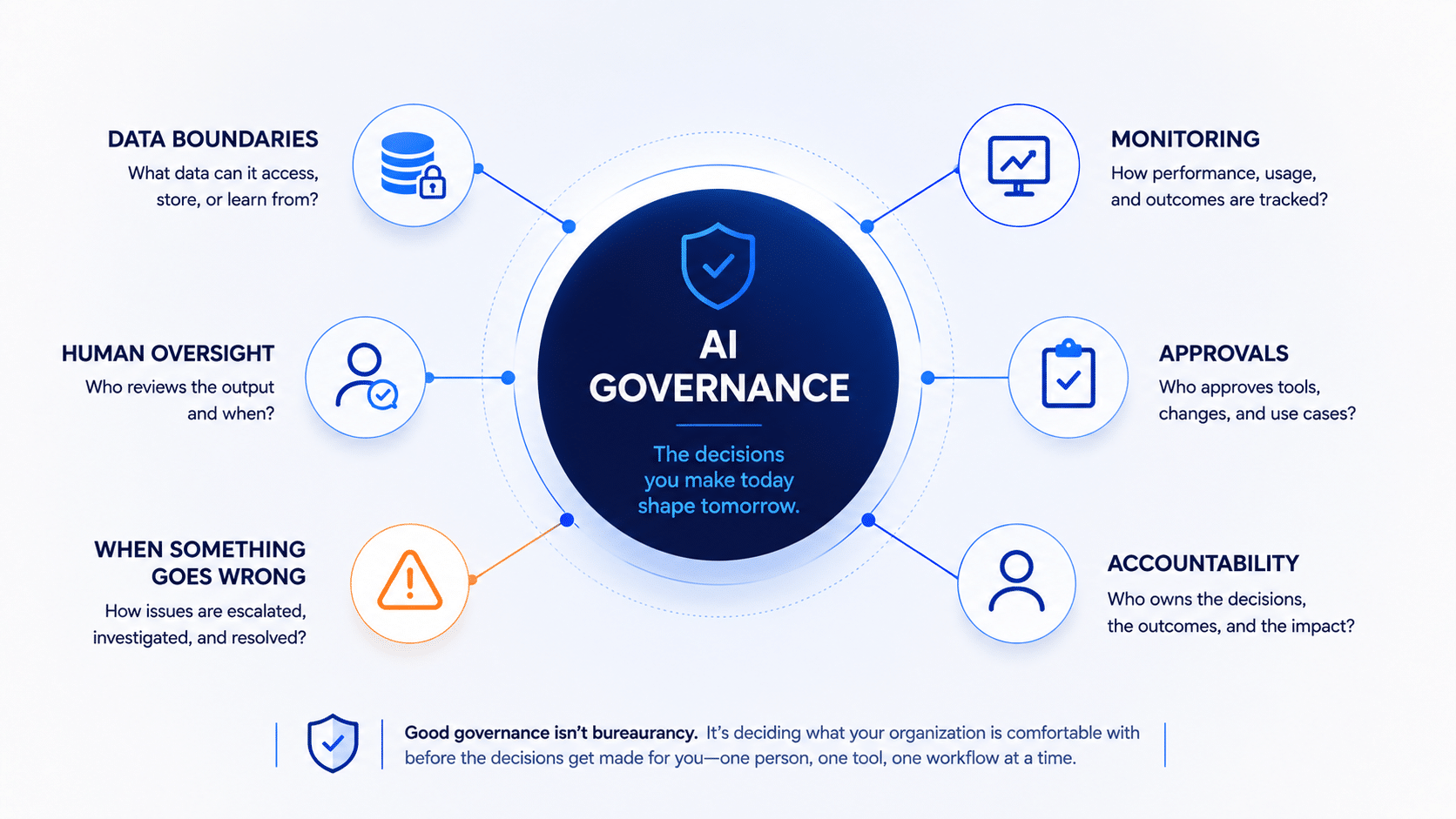
That’s the part worth underlining. In most companies these choices are already being made. They’re just being made quietly, by whoever downloaded something useful on a Tuesday. Those are governance questions whether anyone calls them that or not.
Question to have on deck: who wrote your AI policy, and what did you get wrong the first time?
AI ROI
Everyone knows what ROI means. The harder question is figuring out whether AI actually created it.
When performance improves after a new tool goes live, connecting the two is almost irresistible. But what else changed? Did portfolio mix shift? Was seasonality involved? Was the comparison period unusual? And was the tool running in a controlled pilot or carrying real volume, because those produce very different numbers and get described with the same word.
I’m not skeptical of the results. I’m skeptical of attribution, which is a different thing and a much older problem than AI.
Question worth having on deck: how are you measuring it, and what convinced you it was actually the AI?
The ten questions, in one place
Here they all are together. Screenshot this part if nothing else.
- When you picked your tool, how much did the model underneath matter to the decision?
- Has anyone here run a model in their own environment, and was it worth the setup?
- How much of your early trouble turned out to be the tool, and how much was how you were asking?
- Where did you draw the line on what it can do without someone approving it?
- When it’s been wrong for you, how did you catch it?
- What guardrail did you not think of until something went sideways?
- How do you know the recommendations are adapting, and not just running a rule?
- Did you test on synthetic data first, and did it tell you what you needed?
- Who wrote your AI policy, and what did you get wrong the first time?
- How are you measuring it, and what convinced you it was actually the AI?
Looking at them together, they’re really versions of the same question:
What happened when you actually tried it?
That’s the part I’m most curious about.
Not just what the technology is capable of in theory, but what changed when somebody put it into an actual workflow. What worked. What didn’t. And what they would do differently the second time around.
Those answers tend to be a lot more useful than anything that fits neatly on a slide, and people who have already been through it usually have a pretty good story. That’s a big part of what I’m looking forward to in Denver.
Payment Savvy is proud to sponsor and exhibit at Brainstorm in its inaugural year, and our team will be at booth 32. If you’re there, come say hello. We’d love to hear what you’re exploring, what’s working, and what you’re still figuring out.
And if you’re not going, the conversation is still open. Reach out and tell us what you’re working through. We’d genuinely like to hear it.
PAYMENT SOLUTIONS
FEATURED INDUSTRIES