The Drop-Off Nobody Measures: Payment Abandonment in Collections
TABLE OF CONTENTS
Most agency dashboards can tell you the contact rate. Many can also break down promises to pay by campaign, collector, or time of day.
But few can answer two basic questions:
Of the consumers who start a payment, how many actually finish?
And when they don’t finish, where do they stop?
That missing part of the payment journey is easy to overlook. A consumer agrees to pay, the payment does not settle, and the account appears the next morning as another broken promise.
That doesn’t always mean the consumer changed their mind. Sometimes the payment process lost them.
Every incomplete payment represents intent the agency already worked to create. Improving completion can increase collected dollars without requiring the team to generate another contact or another promise to pay.
What is payment abandonment in collections?
Payment abandonment in collections happens when a consumer begins the payment process but leaves before submitting the transaction. The intent was there. The payment wasn’t completed.
That is different from a payment that was submitted but declined. It is also different from a payment that was approved and later returned.
All three leave the agency without a completed payment, but they’re not the same problem. Three different outcomes. Three different problems.
Declines and returns appear in processor reporting, so most agencies already have some visibility into them. Abandonment is rate that usually goes uncounted, and that’s what we’re focusing on here.
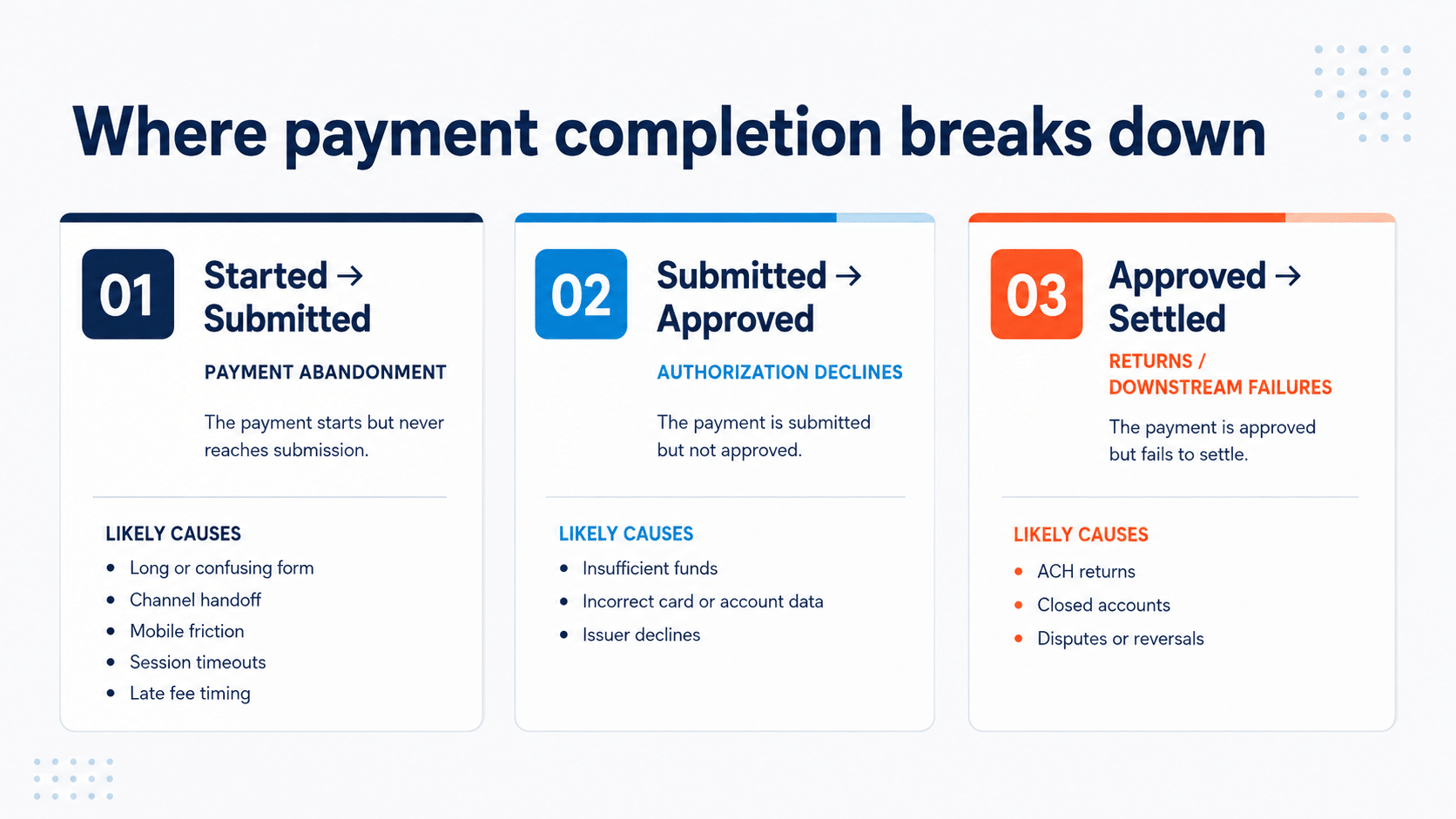
When agencies group everything under a vague ‘incomplete payment’ bucket, they lose the information needed to fix the actual problem.
Where do consumers drop off?
Public benchmarks specific to collection-payment abandonment are scarce. That’s part of the problem — most agencies aren’t measuring it.
Still, there are five places worth checking first.
1. The payment channel changes
A consumer agrees to pay over the phone but receives a link to a portal. Or they agree over text but learn they must call during business hours.
In each case, the consumer starts in one channel and must finish somewhere else. Every handoff adds another step and another chance to lose the payment. The consumer who felt ready to pay at 8:40 on Tuesday night may not feel the same way at 9:15 the next morning.
Whenever possible, the channel that creates the payment intent should also help the consumer complete the transaction.
2. The payment form asks for too much
Entering card details on a phone is not difficult in theory.
In real life, the consumer may be sitting in a car, walking through a store, managing children, or searching through a wallet while trying to keep a browser open. A long form makes that moment harder.
Card number. Expiration date. Security code. Billing ZIP. Name. Address. Account details. Login credentials. Each additional field creates another opportunity for a typo, confusion, or interruption.
Research from Baymard Institute shows that many e-commerce checkouts contain more form fields than they need. Collections and e-commerce are different, but the basic lesson still applies: unnecessary steps make completion less likely.
A collections payment page shouldn’t ask for information the agency already has or does not truly need.
3. The session expires
A consumer pauses to find a card or check a bank balance.
They return a few minutes later and discover that the session has expired. The information they already entered is gone, and they’re asked to begin again.
Some will. Others will decide they have spent enough time on it for now.
Session security matters, but so does understanding how long a real person may need to complete the process. Agencies should review timeout settings, warning messages, and what happens when a consumer returns after a session ends.
4. The mobile experience is difficult
A payment page can open on a phone without being easy to use on one. Small fields, crowded screens, unclear buttons, slow load times, and forms that require constant zooming can all interrupt the transaction.
The best way to understand the mobile experience isn’t to review it from a desktop preview. Open the payment link on a phone. Start at the same place the consumer starts. Try to complete the payment without using information that has already been saved in the browser.
A simple real-world test often reveals problems that are difficult to see from an internal dashboard.
5. The total changes late in the process
A consumer agrees to pay one amount and sees a higher total near the final screen.
Even when the fee is valid, properly structured, and permitted for the transaction, the timing of the disclosure matters.
If someone agrees to pay $200 and later sees a total of $214.95, the experience has changed. The consumer is no longer simply completing the payment they already accepted. They’re being asked to make another decision.
That’s where trust can slip.
Agencies should always review convenience fee payment programs with qualified counsel because these programs carry important compliance considerations.
From the payment-completion side, the direction is straightforward:
- Disclose the fee clearly.
- Disclose it early.
- Show the full amount before the consumer reaches the final confirmation screen.
This clear disclosure also supports compliance and payment completion at the same time.
How should agencies measure payment abandonment?
Start with one number. Of the consumers who started a payment, how many submitted one?
Submitted payments divided by payment starts. The gap is your abandonment. Most agencies have never pulled it, and the pieces are usually closer than they expect.
Your payment provider can tell you what was submitted. Payment starts often live somewhere else — site analytics, the payment page itself, or whoever manages your web properties. Plan on two conversations rather than one.
Then segment it. The overall rate tells you there’s a problem. The breakdown tells you where.
Compare:
- Mobile and desktop
- Agent-assisted and self-service
- Portal, text, phone, and IVR
- Card and ACH
- One-time and recurring payments
- Different fee and no-fee payment paths
You are looking for one thing: the distance between your strongest payment path and your weakest one. That distance is the part you can actually fix.
Desktop submission rates that significantly outperform mobile point to a form or usability issue. Strong payment intent paired with weak submission in one channel points to a broken handoff. A drop concentrated at a single step points at that step.
Where Payment Savvy fits
You do not need a new payment partner to begin measuring abandonment. The steps are already in this article, and much of the initial work can be done using data your team likely already has.
Where Payment Savvy can help is turning what you find into a better payment experience.
Since 2010, we have built payment programs for collection agencies that make it easier for consumers to pay through the channels they prefer. And every program is backed by a team your people can reach. No ticket system here.
We’re happy to review your current payment data, identify where consumers are dropping off, and help prioritize the changes most likely to improve completion. That might mean simplifying a payment path, reducing channel handoffs, adding a missing payment option, or rethinking how fees are disclosed.
Bring us what you find. We will look at it together, identify the most meaningful opportunities, and build a practical path toward helping more consumers reach the finish line.
The distance between “yes” and paid
A promise to pay matters. It shows that the conversation moved forward and the consumer made a decision.
But the payment process still has work to do.
The channel needs to be available. The instructions need to be clear. The form needs to work. And the amount needs to match what was discussed.
Some payments will still fail for reasons no agency or payment provider can prevent.
But the process itself should not be the reason a ready consumer cannot finish.
A promise to pay is progress.
A completed payment is the finish line.
Our job is to make the distance between the two as short and clear as possible.
PAYMENT SOLUTIONS
FEATURED INDUSTRIES