Compelling Evidence 3.0: What Collection Agencies Should Know

TABLE OF CONTENTS
Picture a fraud dispute notice on a collection account. The consumer tells their bank they didn’t make a $150 payment through your agency’s online portal. Yet the same card paid on that account twice last spring, from the same phone, with no complaint either time. Under Visa’s Compelling Evidence 3.0, those earlier payments can matter.
For collection agencies, the practical question is whether the way you accept payments creates records you can use when a consumer challenges a payment. Repeat payments make that question worth asking. A consumer on a payment plan may pay several times over the life of an account, and each online payment leaves a record. On October 24, 2026, Visa widens the range of earlier payments that can count.
We touched on CE3.0 in our post on how to package a chargeback response. This post is educational, not legal advice, and Visa’s current rules always have the final word.
What Compelling Evidence 3.0 is
Visa’s Compelling Evidence 3.0 took effect in April 2023, as Verifi, a Visa company, explains in its CE3.0 overview. It applies to one dispute type: condition 10.4, Other Fraud in a Card-Absent Environment. The cardholder’s bank, called the issuer, uses that code when the cardholder says they didn’t authorize a payment made without the physical card. For an agency, that covers payments through a portal, a pay-by-text link, IVR or an agent on the phone.
The thinking behind it is straightforward. Suppose a card paid before from the same device or internet connection, and the issuer hadn’t reported those payments to Visa as fraud. That history says something about the payment now in dispute. So the rule compares data from earlier payments, such as the device, IP address or login, with the disputed one. Visa and Verifi call the underlying problem first-party misuse. That’s when a cardholder reports a payment they authorized as fraud, whether they mean to or not.
I previously worked at Midigator, a company acquired by Equifax, and CE3.0 was a big part of my work there when Visa introduced it in 2023. That experience still shapes how I look at payment systems. What details do they capture, and can a merchant retrieve those details when a dispute arrives?
How Compelling Evidence 3.0 applies to collections payments
Because the rule depends on data from the cardholder’s own device, the way a consumer pays your agency matters a lot.
When a consumer pays through an online portal or a pay-by-text link, they usually use their own phone or computer. That session can carry an IP address and device details, and a portal login can carry an account ID. A phone payment that an agent keys in works differently. The issuer still treats it as card-absent, so it can still draw a 10.4 dispute. But the payment session typically runs on the agent’s connection, not the consumer’s device. So it usually lacks the consumer-device data CE3.0 compares, and IVR payments raise the same question.
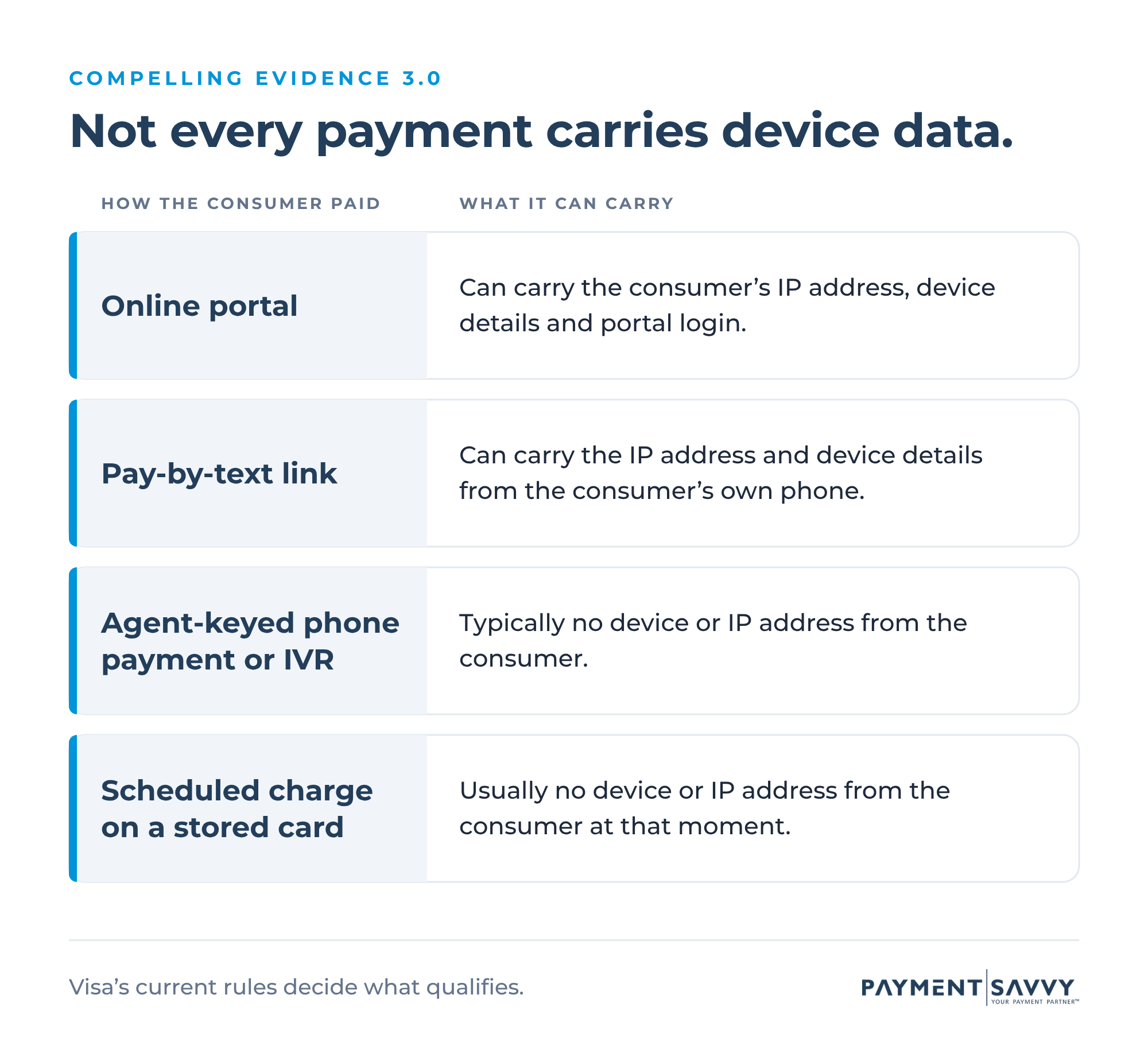
Payment plans deserve a closer look. A consumer might set up a plan online and then let the agency charge a stored card each month. Those scheduled charges usually don’t carry the consumer’s device or IP address from that moment. Even so, Verifi’s CE3.0 FAQ covers how subscription merchants can benefit, so recurring payments aren’t ruled out when the required data is there. The plan builds a long payment history, and the records behind each payment decide whether that history qualifies.
Visa’s list of matching data also includes a delivery address. Nothing ships in collections, so the likely matches for an agency are the IP address, device data and a portal login, where one exists.
What counts as history, before and after October 24
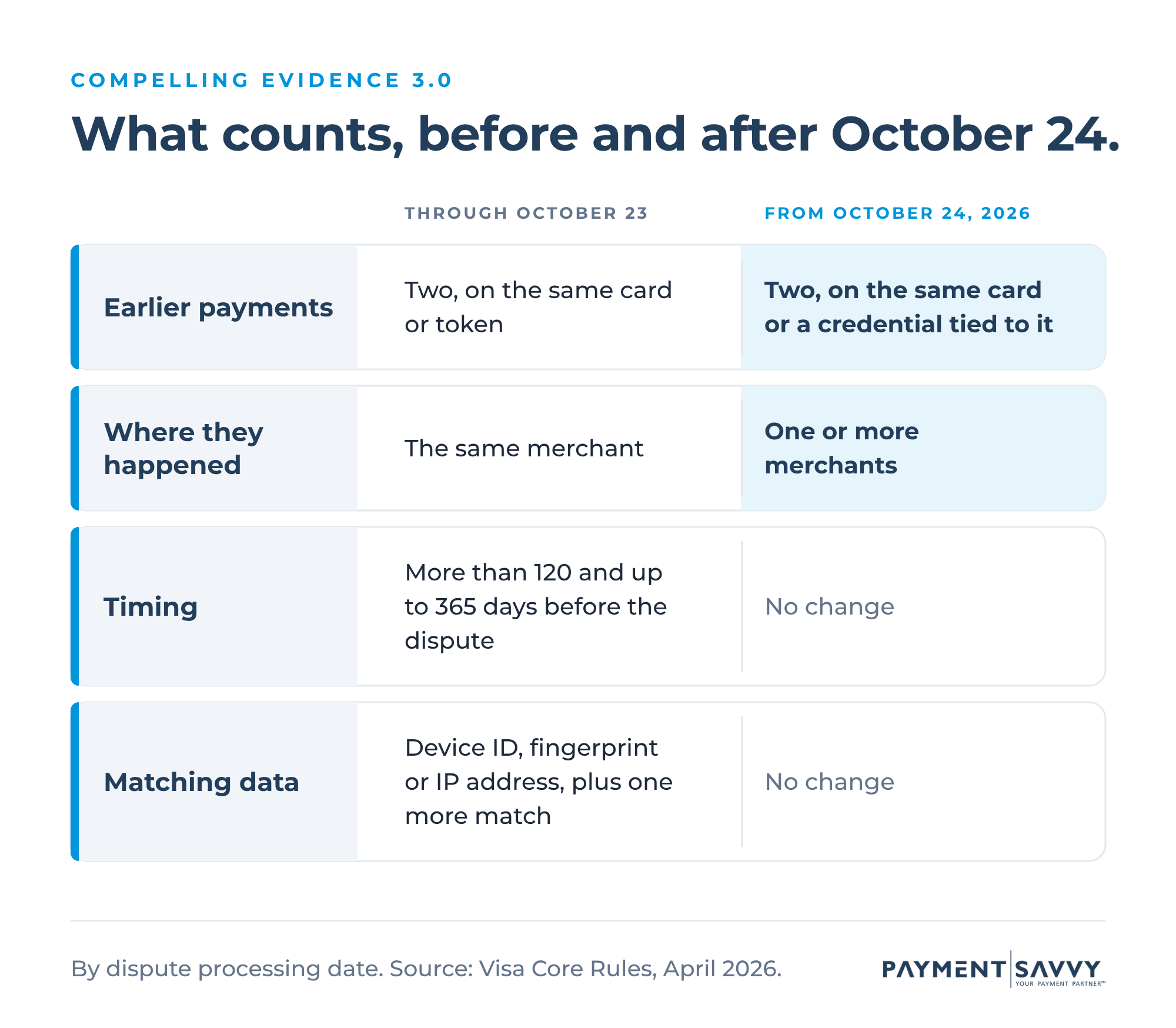
The core of the rule stays the same. A merchant needs two earlier payments on the same card that the issuer hadn’t reported to Visa as fraud before the cutoff in Visa’s rules. Both have to fall more than 120 and no more than 365 days before the dispute’s processing date. The device ID, fingerprint or IP address has to match the disputed payment, plus one more match. Visa also asks for a detailed description of what each payment was for.
The main change follows the dispute’s processing date, not the date of the original payment. For disputes processed through October 23, CE3.0 evidence comes from earlier payments at the same merchant. From October 24, the earlier payments can come from “one or more Merchants,” on the same card or a credential tied to it.
A few details sit alongside that change. The acquirer is the merchant’s processing bank. When it submits this evidence in pre-arbitration, it can submit only transaction data it accepted and processed itself. In pre-arbitration, Visa already treats device ID and device fingerprint as similar data elements, so an acquirer can supply only one of them. From October 24, Visa adds the same rule to the criteria that make a dispute invalid.
Visa also sets a format for each data point. A login ID has to be one the cardholder uses and recognizes, and an IP address has to be the cardholder’s public address. The details are in Sections 11.7.5.3 and 11.7.5.6 of the April 2026 edition of the Visa Core Rules and Visa Product and Service Rules. Visa usually updates its rules twice a year, so check the current edition before you rely on any detail here.
Where the evidence goes
Compelling Evidence 3.0 data can enter at two points. Before a dispute exists, Verifi’s Order Insight lets participating merchants answer an issuer’s inquiry in real time. Visa picks two to five earlier transactions, and the merchant returns the data for them. If the history meets the criteria, the pre-dispute is blocked and liability shifts to the issuer, according to Verifi.
After an issuer files a dispute, the acquirer can submit qualifying data for two earlier transactions in pre-arbitration. Either way, Visa’s rules decide what qualifies, and submitting the data doesn’t guarantee an outcome.
Start with the records you’re creating today
Before a dispute arrives, it’s worth looking at a sample payment from each channel your agency uses. Which details does your payment page or software capture? How long are they kept, and can your team pull them up when a consumer challenges a payment? Include scheduled payments in that look. A payment plan may create months of history, but each record still has to hold the right details.
Payment Savvy has focused on payment processing for collection agencies since 2011. To see how we work with agencies, visit our page on payment processing for collection agencies.
A completed payment is the finish line. When a consumer challenges one months later, the payments that came before it can speak for it.
PAYMENT SOLUTIONS
FEATURED INDUSTRIES