The NYC SHIELD Rule Reaches the Payment Moment

TABLE OF CONTENTS
A consumer in Queens opens a text from your agency, follows the payment link, and resolves a balance. A receipt arrives in their inbox. From their side, the experience is straightforward, which is exactly what your team worked to make possible.
Behind that payment, though, several things had to work together. Someone established permission to send the message. A system delivered the link. Another accepted the payment and generated the receipt. Those pieces may belong to different teams or vendors. The consumer still experiences them as one conversation with your agency.
That is where New York City’s SHIELD Rule becomes a payments conversation.
The NYC SHIELD Rule amends the city’s existing debt collection rules. DCWP currently lists January 1, 2027 as the effective date, after moving it from September 1, 2026. For agencies serving NYC consumers, the preparation includes a close look at what happens when someone is ready to pay.
A note before we start: this article explains what New York City’s SHIELD Rule says. It draws on the Department of Consumer and Worker Protection’s FAQ and rule text, checked September 25, 2026. It’s general education, not legal advice or a compliance checklist. Your counsel is the right source for what it means for your agency.
Why an NYC rule matters to an agency elsewhere
Your office does not have to be in New York for this to matter. DCWP’s FAQ says the rule applies to debt collectors engaged in collection activity with NYC consumers. Its licensing guidance makes the same point. A business collecting personal or household debts from New York City residents needs a DCWP license even if it’s outside New York State. So an agency in Arizona with accounts in Queens or Brooklyn has those accounts to consider too.
The geographic line is the five boroughs, not New York State as a whole. The rule also reaches original creditors engaged in debt collection procedures. Routine billing on accounts outside collection is different.
If NYC consumers are part of your book, the payment questions belong next to your collection scripts and notices. Let’s follow the path from the first payment link to the receipt.
The message carrying the payment link
A payment link gives someone a direct route to act. The message that delivers it has its own requirements. Under the rule’s electronic communication requirements, collectors generally need revocable written consent, given directly to that collector. The consent covers a specific debt and a specific email address or phone number.
The rule makes limited exceptions. One covers consent an original creditor obtained before collection began. Another covers a consumer who contacted the collector about a debt from that address or number within the past 60 days. That exception holds as long as the consumer hasn’t opted out since.
Every electronic message also has to explain how to revoke consent. It has to offer a simple way to opt out by replying “stop,” in the same language as the rest of the message.
That raises a practical question about how permission travels. If a consumer opts out through the collection software, does the system sending payment messages receive the update?
When a reminder joins the conversation
Now imagine the consumer schedules a payment for Friday. A reminder goes out Thursday. Your team already contacted them about the same account earlier in the week. That is where automation and contact limits meet.
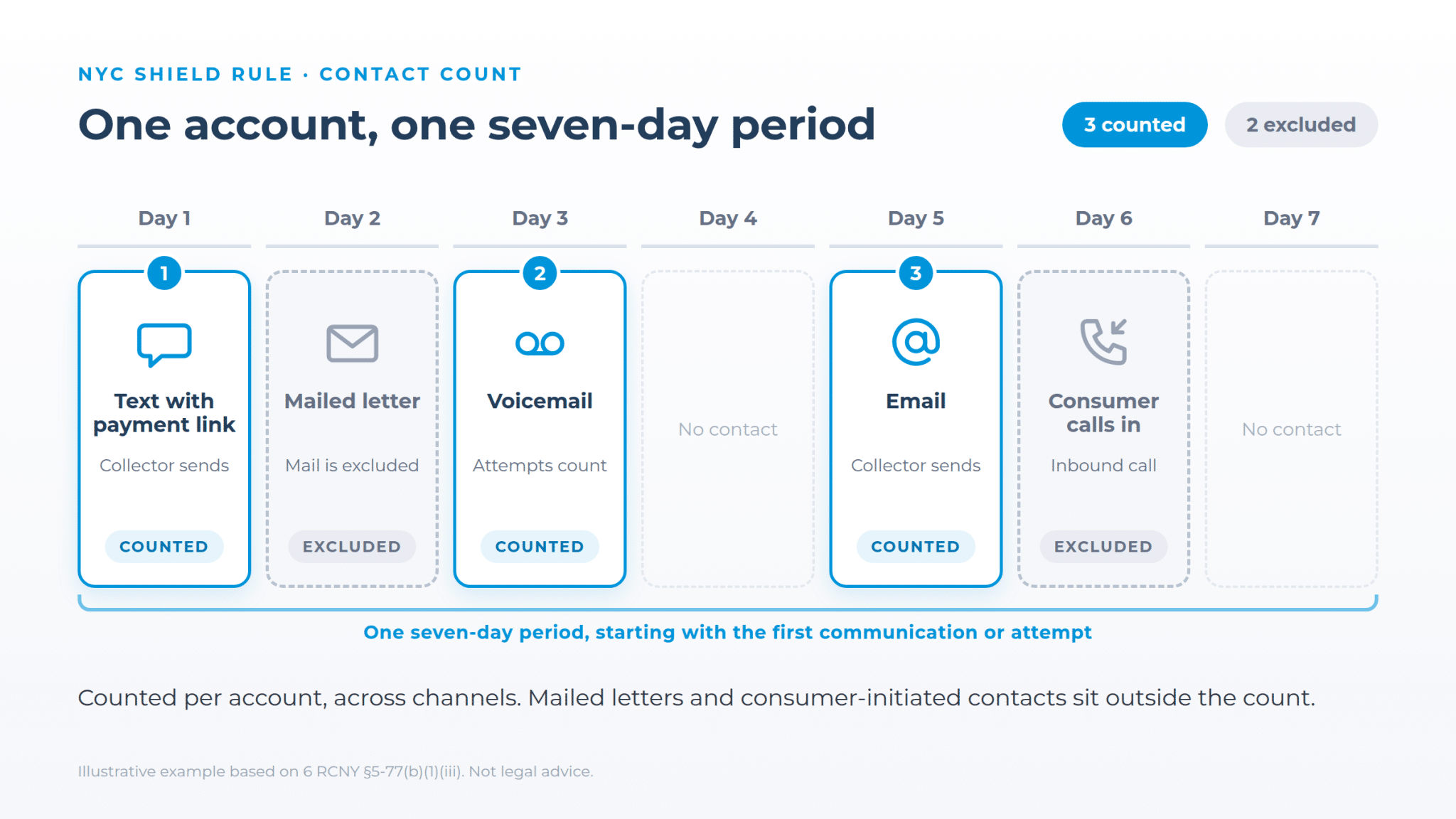
Under the rule, contact within a seven-day period is excessive in two situations. The first is “more than three times in total during such period.” The second is “any time after the consumer responded to a prior communication within such period.” The count runs per account and across channels.
For context, DCWP noted that the city’s earlier rules set the line at more than two collection communications a week. It describes three as giving collectors more room.
Some contacts sit outside the count entirely. The count leaves out mailed letters and anything the consumer initiates. It also leaves out responses in the same live chat, messages that turn out to be undeliverable, and one initial request for consent to communicate electronically.
Neither the rule nor the FAQ addresses payment reminders by name. Whatever the answer for a given reminder, the systems involved have to carry it out. A reminder can work exactly as configured while the information that decides it sits somewhere else, like the week’s contact history.
Before accepting a payment on time-barred debt
This is the provision I’d give particular attention from the payment side. It reaches the ability to receive the money.
For time-barred debt, the rule requires reasonable procedures to determine whether the limitations period has expired. The collector has to mail a Notice of Time-Barred Debt before contacting the consumer and wait 14 days. Later communications need a time-barred disclosure. DCWP’s FAQ explains what happens if the collector misses those steps. The rule then prohibits it from entering into a settlement agreement or receiving payment on that debt from an NYC consumer.
The notice itself explains why the payment matters so much. It tells the consumer the time to sue has expired. It also warns that a payment may restart the creditor’s right to sue. DCWP’s explanation helps here. Under New York law, a payment can’t revive a time-barred debt from a consumer credit transaction. Some debts fall outside that definition, and DCWP gives certain medical expenses, rental arrears, student loans, and auto loans as examples. For those debts, the payment itself can carry legal weight.
A consumer reaching a payment page doesn’t tell the payment system whether any of those steps happened. That information lives wherever the agency keeps the account’s status. It has to reach a self-service payment or an installment that’s already on the calendar. The answer has to carry through to the place where the payment actually happens.
The receipt is still part of the experience
Return to that consumer in Queens. The payment went through, and the receipt may be the last thing they read from your agency that day.
DCWP specifically names payment receipts among communications that need a specific disclosure. The receipt has to say the collector is attempting to collect a debt, and that it will use any information it obtains for that purpose. Depending on the setup, the wording may come from the agency, its collection software, or a payment provider. The delivered version is the one the consumer reads.
A payment fee belongs in the picture too
If a fee appears when the consumer makes a payment, the rule has something to say about it. It restricts collecting any amount, including a fee or charge, unless the agreement creating the debt expressly authorizes it or the law permits it.
We explored how fees work in our surcharge and convenience fee article. Our earlier post on convenience fees for collection agencies goes deeper on setup. Here, the rule’s condition applies to the amount shown before payment and on the receipt.
Where the rule meets the payment
Much of the SHIELD Rule reads like it’s about conversations. Who can a collector contact, how often, and what does the consumer need to hear? At the payment moment, systems carry those conversations. Consent, contact history, and account status all have to reach the place where the payment happens. That’s why a city rule about debt collection ends up being a payments story too.
For more detail, read DCWP’s current FAQ or join its October 5 webinar at 2 p.m. Eastern.
A closer look at the payment path
Payment Savvy has worked with collections and ARM teams for 15 years. We know a payment is rarely just a transaction. It starts with how the consumer was contacted and ends with what they see on their receipt. Along the way, the payment experience depends on information held across different systems.
If NYC consumers are part of your portfolio, now is a good time to follow that path through your own operation. Where does the payment process depend on information held somewhere else? If you’d like to talk through what you find, our team is here to help.
PAYMENT SOLUTIONS
FEATURED INDUSTRIES