Your Payment Channel Mix Is Only Half the Job
TABLE OF CONTENTS
Somewhere in the last few years, the industry settled a question it had been arguing about for a decade.
Consumers want options. So give them options.
Portal. Pay-by-text. IVR. Digital wallets. ACH. Card. Recurring payments. Most operations I talk to today have several ways for someone to pay.
That was the right call.
But having the options and actually getting consumers to use them are two different jobs.
A payment channel can be technically live, fully integrated, sitting in the contract, and still be almost invisible to the people it’s supposed to serve. And when usage is low, it’s tempting to decide the channel isn’t working.
Before you do that, I’d ask a different question:
Did the channel fail, or did we never really put it to work?
I’m writing this from the collections side because that’s the world I work in and the industry Payment Savvy knows best. But the same question applies in medical billing, property management, utility receivables, lending, and plenty of other places where people need to resolve a balance.
And I’m a customer marketer at heart. Always have been. So I have a hard time looking at an underused payment option without immediately wondering about adoption. Who’s seeing it? When are they seeing it? Is the path obvious? What does the behavior tell us?
We’ll get to that part.
Payment behavior stays more varied than we think
There is a reason I don’t love building payment strategy around demographic assumptions.
PayNearMe surveyed roughly 1,574 U.S. consumers in 2024, and some of the generational findings don’t fit the usual story.
Gen X reported the strongest preference for several alternative ways to pay. Fifty-one percent named Venmo as a preferred payment method, and 37% wanted access to pass-through mobile wallets such as Apple Pay and Google Pay. Forty-six percent of baby boomers said they use smartphones to pay their loans.
And here’s one I particularly like: 60% of boomers said text or email payment reminders would be very helpful, the highest percentage of any age group in the study.
None of that means age tells us nothing.
It means age doesn’t tell us enough.
The Federal Reserve’s 2026 Diary of Consumer Payment Choice makes the same point from a much wider angle.
Consumers averaged 47 payments a month, including 16 by credit card, 15 by debit card, and six in cash. Cash remained the third most-used payment instrument for the sixth year running, and four out of five consumers had used cash within the previous 30 days.
Rural consumers averaged nine cash payments per month compared with six among suburban and urban consumers. Adults 55 and older and households earning less than $25,000 a year also relied more heavily on cash than other groups.
Ten years into the supposedly cashless future, people are still stubbornly people. Their payment behavior varies, and our payment experiences should leave room for that.
Low volume does not automatically mean low value
This is where I want to be careful, because an audit of your payment mix could easily turn into the wrong exercise.
I’m not arguing for a shorter list of payment options.
Quite the opposite.
If one channel represents only five percent of your payment volume, that’s still a group of consumers choosing to pay you that way. Before deciding the channel isn’t worth keeping, figure out what the low volume actually means.
Maybe demand is genuinely low.
Maybe consumers aren’t seeing the option.
Maybe they’re seeing it and running into friction.
Maybe your workflows naturally route people somewhere else.
Those are very different problems, and only one of them suggests the channel itself may be the issue.
Breadth matters. Different consumers need different ways to reach the finish line.
The next job is making that breadth useful.
Preference shows up in behavior
McKinsey’s collections research found that consumers who preferred digital contact were 12% more likely to make a payment when contacted through their preferred channels. Among consumers who preferred traditional contact, issuers saw 17% better results using phone and letter.
Those figures measure contact strategy, not which payment method someone ultimately used, and the study dates back to 2019. I wouldn’t turn them into a current benchmark.
But the principle is useful: matching matters in both directions.
And your own data can often tell you things a broad demographic benchmark can’t.
A consumer who repeatedly completes payments through IVR is giving you a behavioral signal.
Someone who responds to a text reminder, follows the payment path, and does it again the next month is giving you one too.
We spend a lot of time trying to predict preferences.
Sometimes consumers are already showing us.
Live and offered are not the same thing
This distinction matters more than it sounds.
TransUnion’s 2023 survey of 212 third-party collection professionals found that 98% of firms were still using letters to communicate with consumers, while 40% were using text or SMS.
That’s a communication-channel statistic, not a payment-completion statistic. But it illustrates something I see as an operator: adding a capability and making it part of the actual experience are different things.
So rather than assuming an underused channel isn’t valuable, I’d start asking questions.
Pay-by-text is available. How often do consumers actually encounter it?
IVR is live. How early and clearly does the self-service option appear?
Recurring payments are supported. When does someone actually learn that’s an option?
Digital wallets are enabled. Are they easy to find on the devices consumers are using?
A capability can work exactly as designed and still underperform if nobody has thought much about how consumers discover it.
Nothing has to be broken.
Sometimes it just hasn’t been activated.
IVR still has a job to do
IVR sometimes gets treated like the old-fashioned option sitting next to all the shiny digital channels.
I wouldn’t write it off.
Datatel’s 2025 report on IVR payment adoption looked at usage across healthcare, utilities, financial services, and government organizations, including a focal case with more than 10,000 monthly pay-by-phone interactions.
In that case, payments that started out 98% agent-assisted shifted to almost entirely self-service within a year as IVR adoption grew. The organization didn’t simply install IVR and wait. It changed call routing, staff behavior, scripts, phone greetings, and channel promotion along the way.
It’s a vendor case study, not a universal benchmark, and I’d treat it accordingly.
But I think the underlying lesson is useful:
People can’t use an option they don’t know exists.
Datatel recommends putting the IVR payment option within the first 20 seconds of the phone tree, along with promoting it through other communications and making sure staff understand when and how to offer it.
IVR can be especially useful when someone wants to make a payment quickly without logging into a portal, hunting through an old email, or talking to an agent. It also gives consumers another self-service route outside normal business hours.
That’s not legacy.
That’s choice.
Recurring payments solve a different kind of friction
Recurring payments often get filed under convenience. I think that undersells them.
A recurring arrangement can turn a series of future payment decisions into one decision today.
That matters because every future payment otherwise has to compete for someone’s attention all over again.
But there is another side to it.
In PayNearMe’s generational research, baby boomers had the lowest percentage of respondents paying all of their loans through autopay, at 35%. Among boomers who hadn’t set up autopay, 78% said it was because they wanted control over when their bills were paid.
That sounds less like resistance to technology and more like cash-flow management.
And that’s useful.
The lesson isn’t to push autopay harder. It’s that timing and control matter as much as convenience does.
Sometimes the difference between an option existing and an option working is how well it fits the reality of the person using it.
Give me 15 minutes with your numbers
This is not a reporting exercise for the sake of producing a prettier report.
You’re looking for something practical: a low-lift opportunity to improve payment completion using capabilities you may already have.
Here’s how I’d do the first pass.
And let me be straight with you about the fifteen minutes, because I don’t want to undersell what I’m asking for. Step 1 really does take about that long, and it’s the step most likely to show you something on its own. After that it depends on your reporting. If your data is clean, call it an afternoon. If it isn’t, give it a little more. Worth knowing before you start.
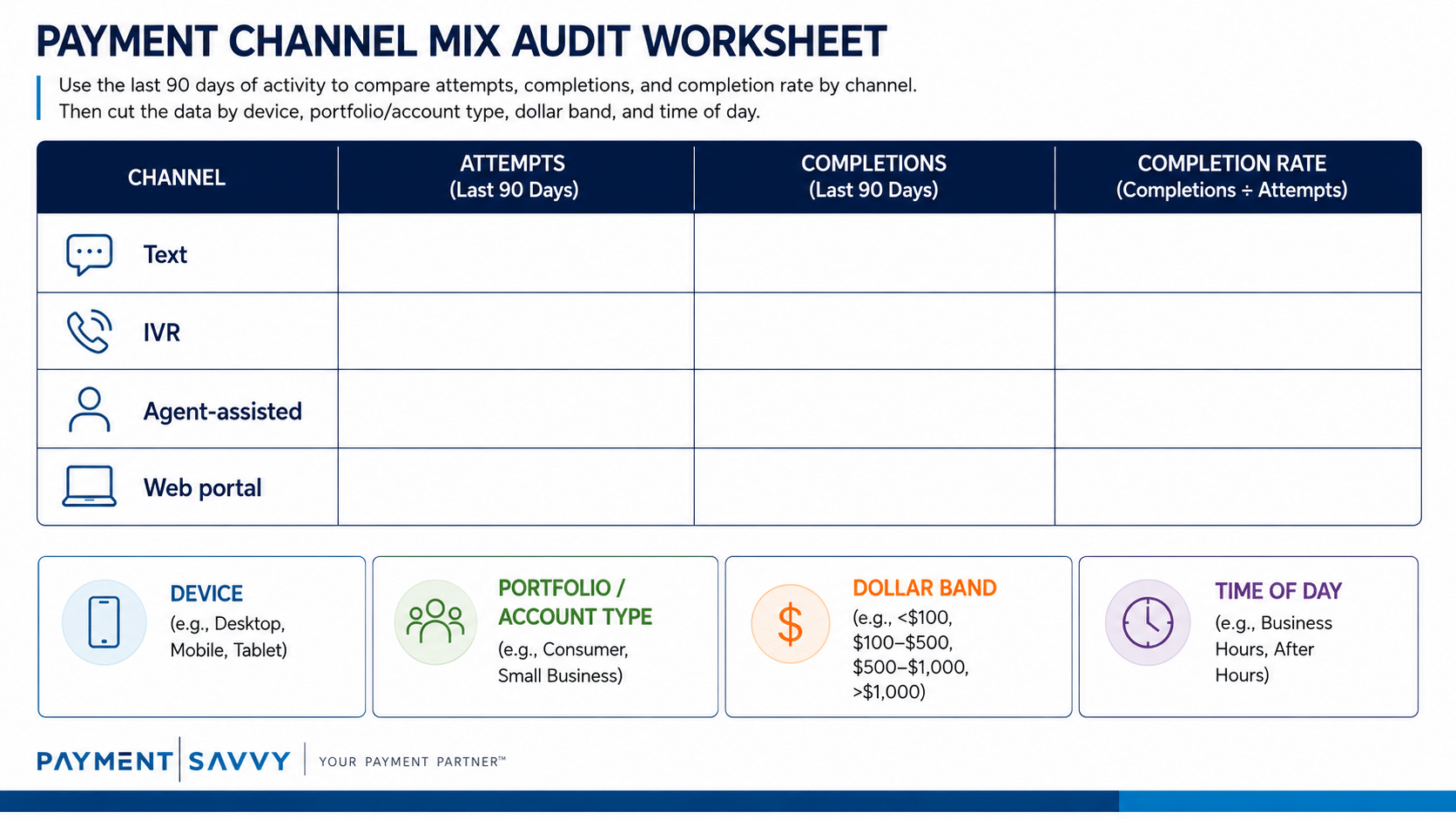
Step 1: Write down what’s actually live
Start simple. List the payment options currently available to consumers.
Don’t start by deciding which ones are good or bad. You’re establishing the baseline.
Then ask how consumers reach each one. Through an agent? An email? A text? Your website? IVR? A payment portal?
You may spot something before you pull a single report.
Step 2: Pull the last 90 days of activity
Break payment activity out by the channels or payment options your reporting can identify.
Volume is useful, but don’t stop there.
Before we go further, your reporting does not need to be sophisticated for this to work. Most operations can’t see every stage of a payment, and that has never stopped anyone from finding something useful. Use the cleanest data you actually have and work with what you can see.
Where your systems allow it, look at the payment journey as stages:
Started → Submitted → Approved → Settled
A lot of starts with few submissions may point to friction before the consumer ever tries to authorize the payment.
Strong submissions with weak approvals tell you something different.
Approved payments that later return or get disputed belong in another category again.
Different problems need different fixes.
Step 3: Add context where it’s useful
Now cut the data a few ways, if your systems support it.
Look at device. A portal can perform beautifully overall while hiding a lousy mobile experience.
Look at portfolio or account type. Different balances and different consumers may behave differently.
Look at payment amount.
Look at time of day. After-hours activity can tell you quite a bit about how much consumers value self-service.
You don’t need a giant analytics project here. You’re looking for patterns obvious enough to deserve another question.
Step 4: Look for two kinds of opportunity
The first is friction.
A channel gets used, but completion falls apart somewhere in the experience.
The second is invisibility.
A channel barely gets used at all.
That second one is easy to misread. Low usage may mean consumers don’t want it. It may also mean they rarely see it.
Find out which before you make the call.
Step 5: Pick one thing and test it
Don’t rebuild the whole payment strategy because of a spreadsheet.
Pick the clearest opportunity.
Maybe you make an existing payment option easier to find. Maybe you change where a self-service option appears. Maybe you simplify a step that’s losing people. Maybe you give one portfolio a different payment path and compare what happens.
Then measure it again.
That’s the point of the exercise.
You’re not trying to prove every channel deserves equal volume.
You’re trying to find where the payment experience can work harder without automatically assuming the answer is another technology purchase.
And yes, if you find one of those opportunities and improve completion, that can turn into real recovery.
Sometimes the next dollar is hiding in something you’ve already built.
And this is where the marketer in me gets excited
See? And you thought marketers just wrote pretty copy and spent our days reminding you to use the latest branding deck.
Turns out, we obsess over adoption too.
Customer marketing, in particular, asks a very similar set of questions: What does the customer already have? Are they using it? If not, why not? What would make the value easier to see, easier to access, or easier to repeat?
I think payment-channel activation deserves some of that same thinking.
If pay-by-text is available, when and where could a consumer reasonably learn about it?
If an email asks someone to make a payment, how obvious is the path from the message to actually paying?
If IVR includes self-service, how quickly does the caller hear that option?
Do the people speaking with consumers understand all the ways someone can pay?
If someone has successfully used one payment route before, can you make that route easy to find again?
And if recurring payments are available, are they introduced at a moment when they make sense?
None of this means adding more noise.
Any communication still needs to respect applicable consent requirements, consumer preferences, legal requirements, and your own policies.
This is simply activation: taking something you’ve already made available and thinking deliberately about whether the people it was built for can actually find and use it.
Three questions, and what to do with the answers
Which payment option has strong completion but relatively little usage?
Before you change the channel, look at exposure. You may have an activation opportunity sitting right in front of you.
Which option gets plenty of activity but loses people along the way?
That’s where I’d investigate friction. Look at the experience itself before you decide the payment option is the problem.
What is technically live today that consumers may barely know exists?
Go see how, when, and whether you’re actually presenting it.
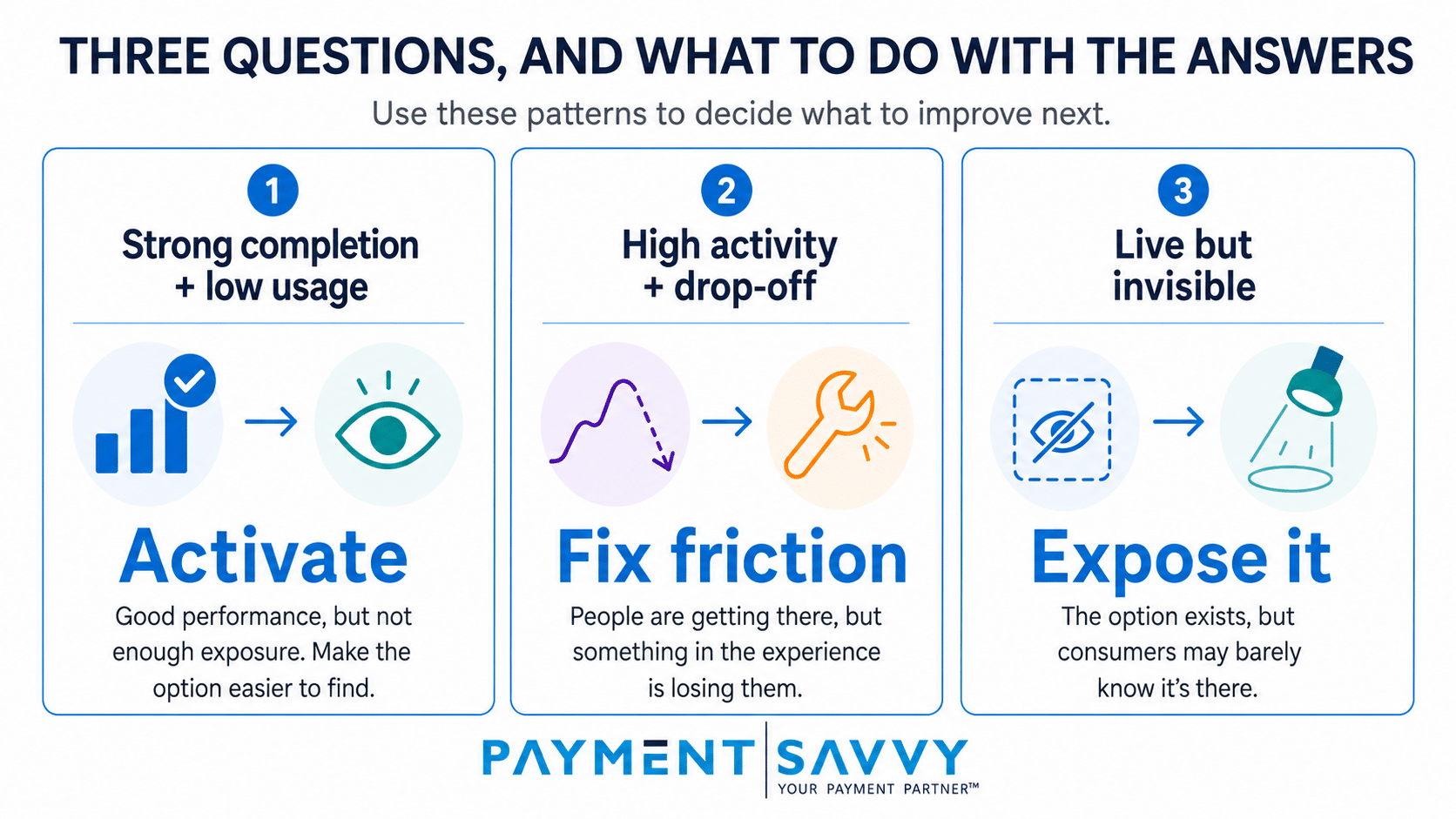
Those three answers give you somewhere to go next.
Protect what’s working, fix what’s creating friction, and activate what’s useful but invisible. Only then decide whether something truly no longer belongs in the mix.
Where Payment Savvy fits
Payment Savvy was built around the payment moment.
We give collection agencies and accounts receivable organizations one partner across credit and debit cards, ACH, digital wallets, IVR, pay-by-text, recurring payments, real-time reporting, and deep software integrations.
But the goal isn’t to win by having the longest list of features.
It’s to make it easier for consumers to pay when they’re ready.
Sometimes that means adding the right payment option.
Sometimes it means removing friction inside an existing one.
And sometimes it means realizing you’ve already built the capability you need. You just haven’t fully put it to work yet.
Built for the finish line means paying attention to what happens when the consumer actually gets there.
If you’d like a second set of eyes on your payment setup, we’d welcome the conversation.
PAYMENT SOLUTIONS
FEATURED INDUSTRIES