The Collection Agent’s Playbook: Tips, Scripts, and Strategies for Successful Recovery

TABLE OF CONTENTS
A successful collection call combines three things: preparation, a compliant and empathetic tone, and a plan for the objections you’ll hear. Review the account before dialing, open with a clear identification and purpose, use language that builds cooperation instead of resistance, and know your FDCPA obligations cold. Agents who do all four consistently close more payment arrangements and generate fewer complaints.
Collection calls carry your agency’s cash flow on every dial, along with legal risk and, for the person on the other end, real financial stress.
This guide covers debt collection tips for preparing before you dial, opening the call. We’ll also look at the five principles that separate a productive call from a combative one, scripted responses to the three excuses you’ll hear most, the words that build cooperation versus the ones that invite a complaint, a call framework you can build your own scripts from, and guidance on timing and follow-up.
Whether you’re running collection agency training for a new hire or refreshing a veteran’s habits, treat this as the debt collection advice your team turns to for how to make collection calls that get results without crossing a compliance line.
Quick Facts
- Regulation F (12 CFR Part 1006), the CFPB’s rule implementing the FDCPA for debt collectors, took effect November 30, 2021, and added specific safe harbors for calling frequency and electronic communication.
- Under the “7-in-7” rule, a collector is presumed compliant calling a consumer about one specific debt no more than seven times within seven consecutive days, and must wait seven days after an actual phone conversation about that debt before calling again.
- The FDCPA presumes 8 a.m. to 9 p.m. in the consumer’s own time zone as the only acceptable calling window.
- Every initial communication must disclose that the call is from a debt collector and that any information obtained will be used to collect the debt, the so-called mini-Miranda disclosure.
- Consumers have 30 days from the initial written notice to dispute a debt in writing; once disputed, collection activity on that specific claim must pause until verification is provided.
- The FDCPA also limits who a collector can discuss the debt with, generally the consumer, their attorney, and a handful of narrow exceptions, not employers, neighbors, or family.
Disclaimer: This guide is written for training and operational purposes and is not legal advice. FDCPA and Regulation F obligations can vary by state, account type, and individual circumstances; have your compliance counsel review any script, disclosure, or process before your agents use it with consumers.
How Should You Prepare Before Making a Collection Call?
Professional debt collection starts before you ever pick up the phone; preparation is the single biggest predictor of how a call will go. Pull the account before dialing: payment history, prior call notes, dispute flags, and the exact balance and aging.
Agents who say “I’ll get back to you on that” mid-call have already lost leverage, because they’ve handed the debtor an unearned grace period and have to restart the relationship on the next attempt.
Check whether the account has already generated a written dispute under 15 U.S.C. § 1692g, and confirm validation was sent before you place the call. Also, check for any prior “do not call at work” or attorney-representation notes, since both change what you’re legally permitted to do next. A five-minute review prevents the two most common compliance mistakes: calling on a disputed, unverified debt, and contacting someone who has already invoked a legal protection on file.
Once the facts are in front of you, shift from “collecting a debt” to “offering a resolution.” You’re calling with options the debtor may not know they have, from a collection agency merchant account(opens in new tab) that accepts card and ACH payments to a structured plan, and that framing changes your tone before you’ve said a word.
How Do You Open a Collection Call the Right Way?
The first fifteen seconds set the tone for everything that follows. State your name, your company, and the purpose of the call clearly and without hesitation; hesitation reads as either dishonesty or discomfort, and both undermine your authority.
Immediately after your identification, deliver the required mini-Miranda disclosure: the call is from a debt collector, and any information you gather will be used to collect the debt.
A sample opening looks like this:
That structure covers identity verification, legal disclosure, and tone-setting at once. From there, state the purpose plainly, “I’m calling about your account with a current balance of $X,” rather than dancing around the reason for the call.
Tone matters as much as content in this window.
A flat, rushed disclosure invites suspicion; a warm, measured delivery signals a normal business conversation, not a threat. Practice the opening out loud until it sounds natural, because a scripted-sounding open is one of the fastest ways to lose a debtor’s attention before you’ve reached the reason for the call.
What Are the 5 Principles of an Effective Collection Call?
Every well-run collection call rests on five habits. These are the effective debt collection strategies and collection call techniques that separate agents who close arrangements from those stuck redialing the same accounts, regardless of the excuse, industry, or debt size on the other end of the line.
1. Confidence
You are offering a way out of a stressful situation, not asking for a favor. Confidence increases when you can offer multiple ways to pay, card, ACH, or an online portal, since a debtor with no easy payment path has no easy reason to commit. In practice, that sounds like: “I can take care of this for you right now over the phone, whichever way is easiest,” delivered without a hint of apology for asking.
2. Professional, positive tone
Treat every call, including your fifteenth of the day, with the same energy as your first. Speak slowly, articulate clearly, and avoid eating, chewing gum, or multitasking on the line; debtors hear all of it as disrespectful.
A short reset between a difficult call and the next one, even 60 seconds of quiet, keeps a bad interaction from bleeding into the next account.
3. Authority without aggression
Be firm about the balance owed and the need for a plan without raising your voice or issuing threats. Record a practice call and listen back; most agents are surprised where their tone drifts toward pressure without meaning to. The line to hold is “This balance is due, and I want to help you resolve it today,” not “You need to pay this or else.”
4. Active listening and flexibility
No single script works on every debtor. Listen for the actual objection behind the words, then match your response to that circumstance instead of reciting the same offer regardless of what you just heard. A debtor citing a job loss needs a different plan than one who simply forgot, even though both may open with “I can’t pay right now.”
5. FDCPA-compliant language
Every principle above collapses if the call violates the FDCPA: no threats of action you don’t intend to take, no misrepresenting the amount owed, and no calling outside the 8 a.m. to 9 p.m. window in the consumer’s time zone. Compliance isn’t a constraint on a good call; it’s a component of one, since a debtor who feels legally protected is more likely to engage rather than avoid you.
How Do You Handle the Most Common Debtor Excuses?
Three excuses account for the overwhelming majority of stalls you’ll hear on a collection call. Each has a pattern, and each has a response that moves the conversation toward resolution instead of a repeat call next week.
“The check is in the mail.”
This is one of the oldest stalling tactics in collections, and it’s rarely accurate. Instead of accepting or challenging the claim directly, offer a payment method that removes the ambiguity: “I understand a check may be on its way. In the meantime, I can process a card or ACH payment right now over the phone so we can close this out today, would that work better for you?” A debt collection merchant account(opens in new tab) that supports card and ACH capture on the call makes this response feel credible rather than theoretical.
“I can’t afford it right now.”
This excuse sometimes masks a genuine hardship, illness, job loss, a family death, or a business slowdown, and it deserves an empathetic response before a procedural one. Acknowledge the difficulty first: “I’m sorry to hear that, and I want to find something that actually works for your situation.”
A debtor who’s reluctant to write a check may still be willing to pay by card, since it doesn’t require confronting a bank balance directly. Then move to options: a reduced partial payment today, a structured plan, or self-service tools like an online bill negotiation portal that lets the debtor set up a plan on their own time without another call.
“I dispute this debt.”
Take this seriously every time; some disputes are valid, and dismissing one out of hand is both bad practice and a compliance risk. Ask specific questions about what’s being disputed, document the response, and if the debtor wants it in writing, remind them of their right to dispute in writing within 30 days. If a written dispute comes in, collection activity on that account must pause until you’ve provided validation.
Which Words Work Best in Debt Collection (And Which to Avoid)?
Word choice shapes whether a debtor sees you as an adversary or a partner in resolving the account. Reciprocity language, phrases that signal you’re offering something rather than demanding something, produces better outcomes than confrontational phrasing. “Sorry” signals empathy and “help” signals partnership, and both tend to lower a debtor’s defenses enough to have a real conversation about payment.
On the compliance side, the FDCPA prohibits specific language outright: threats of action you don’t intend or aren’t legally able to take, misrepresenting the amount or legal status of the debt, and language intended to harass rather than inform.
A single aggressive phrase, “you’ll regret not paying,” can turn a routine call into a formal complaint, so default to plain, factual language over anything that sounds like a threat.
What Does a Sample Debt Collection Call Script Look Like?
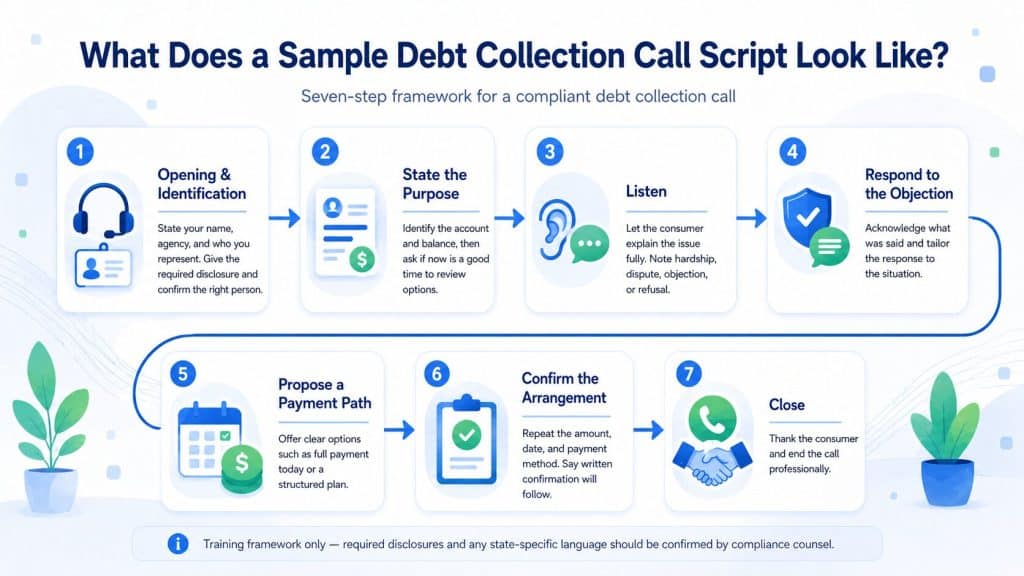
Rather than a word-for-word script, use this seven-part framework as a debt collection call script sample your team can build from; it’s a training structure, not legal advice, and your compliance counsel should confirm required disclosures and any state-specific language before agents use it with consumers.
1. Opening and identification. State your name, your agency, and who you’re calling on behalf of. [Required: mini-Miranda disclosure here, confirm exact wording with compliance.] Confirm you’re speaking with the right person before continuing.
2. State the purpose. Name the account and balance plainly, for example, “I’m calling about your account with a current balance of $[amount],” then ask if now is a good time to go over options.
3. Listen. Let the debtor respond fully before addressing what they said. Note the specific objection, hardship, dispute, or refusal, so your next line matches what you actually heard instead of a generic rebuttal.
4. Respond to the objection. Acknowledge what they said, then pivot to options: “I understand, and I want to find something that works.” Match the response to the excuse type covered above rather than reciting one fixed line regardless of the situation.
5. Propose a payment path. Offer at least two ways to resolve the balance: a full payment today or a structured plan, and let the debtor choose. Naming a specific option, such as two payments over 30 days, moves the conversation faster than an open-ended “what can you do?”
6. Confirm the arrangement. Repeat the amount, date, and payment method back before ending the call, and state that written confirmation will follow.
7. Close. Thank the debtor by name and end on the same professional, unhurried tone you opened with.
Build a short library of collection call scripts examples for your most common scenarios, hardship, dispute, refusal, mapped to this framework, so agents aren’t improvising compliance language in the moment. Flag every required disclosure inline in each version, and route any new or edited script through compliance before it reaches the floor.
When Is the Best Time to Call, and How Should You Handle Follow-Ups?
Timing has a bigger effect on connect rates than most training programs give it credit for. Ask directly, on the first contact, when the debtor is generally available, then note it on the account so the next agent isn’t calling into the same voicemail. This single habit reduces wasted attempts more than almost any script change.
Stay inside the FDCPA’s 8 a.m. to 9 p.m. window in the consumer’s own time zone, not yours, and respect the 7-in-7 limit on attempts to a specific debt.
When a call goes unanswered, log the attempt and move to the next scheduled window rather than redialing repeatedly on the same day. Persistence works when it’s spaced and purposeful; it becomes a liability when it turns into repeated same-day attempts that read as harassment.
Two Regulation F details are worth building into your call logic directly. A limited-content message, a voicemail that gives only the callback number and a business name without disclosing it’s about a debt, is treated separately from a standard call attempt, so check with your compliance team on how your dialer counts these against the 7-in-7 total.
And a call the consumer places to you doesn’t count toward your seven attempts, though it still starts a new seven-day waiting period if you and the consumer actually speak about the debt.
Payment Solutions Built for Collection Agencies
Every one of these debt recovery strategies works better when your agency can take a payment the moment a debtor agrees to one.
Payment Savvy works with collection agencies to set up merchant accounts built for that exact moment: card, debit, and ACH processing, an online bill negotiation service(opens in new tab) for debtors who prefer to set up a plan on their own time, and company-branded receipts that reinforce legitimacy after the call ends. We’ve built this payment infrastructure for the ARM industry specifically, not adapted it from a general merchant account template.
If your agents are closing arrangements on the phone but losing them at the payment step, that’s a processing gap, not a training gap. Request a free quote(opens in new tab) to talk through payment options built for how your agency actually collects.
Frequently Asked Questions
What is the best way to start a collection call?
State your name, your agency, and the purpose of the call clearly, then deliver the required mini-Miranda disclosure that this is an attempt to collect a debt. Lead with a measured, professional tone rather than an aggressive one; debtors respond to tone within the first few seconds. Confirm you’re speaking with the right person before discussing any account details.
What should a debt collector never say?
Never threaten action you don’t intend to take, misrepresent the amount or legal status of a debt, or use language meant to harass rather than inform, all of which the FDCPA prohibits outright. Avoid absolute statements like “you have no choice” or “this will ruin your credit forever.” These phrases both violate the law and reliably trigger consumer complaints.
How do you deal with a debtor who refuses to pay?
Stay calm, document the refusal, and offer alternative arrangements like a smaller partial payment or an extended plan before escalating. If the debtor still refuses after reasonable options are presented, follow your agency’s documented escalation path, which may include referring the account back to the creditor or, in some cases, legal action.
What makes a collection call successful?
Preparation before the call, a confident and professional tone, flexibility to match the debtor’s actual circumstances, and fluency in FDCPA requirements all combine to produce successful outcomes.
Agents who hit all four consistently close more payment arrangements per call and generate fewer consumer complaints than those relying on a single fixed script. These are the successful debt collection techniques most training programs teach first.
How do you handle an angry debtor on the phone?
Stay neutral and avoid mirroring the debtor’s tone, since matching anger with anger escalates the call rather than resolving it. Let them finish speaking, acknowledge the frustration without agreeing to false claims, and redirect to the next steps calmly. If the call becomes abusive toward the agent, it’s appropriate to end the call and follow up later.
What is required by law on a collection call?
Every debt collector must disclose that the call is an attempt to collect a debt (the mini-Miranda, 15 U.S.C. § 1692e(11)), call only between 8 a.m. and 9 p.m. in the consumer’s time zone (15 U.S.C. § 1692c(a)(1)), and honor call-frequency limits under Regulation F. This is general guidance, not legal advice; consult your compliance counsel for obligations specific to your agency and state.
Every Principle Ends at the Payment
Every technique in this guide, from the opening disclosure to the last objection you’ll handle today, is aimed at the same outcome: a debtor who agrees to pay and a way to actually collect that payment before the call ends. Preparation, tone, and compliant language get you to yes. What happens in the next thirty seconds determines whether that yes becomes a completed transaction or a broken promise.
Get a free quote from Payment Savvy(opens in new tab) and ask about card, ACH, and online bill negotiation options built specifically for collection agencies, along with our stated terms on 24/7 US-based support and next-day funding.
Disclaimer: This article is provided for general training and operational purposes only and does not constitute legal advice. Debt collection laws, including the FDCPA and Regulation F, are subject to change and vary by jurisdiction; consult a qualified attorney or your compliance department for guidance specific to your agency.
Sources
- Consumer Financial Protection Bureau, “Debt Collection Practices (Regulation F)”: https://www.consumerfinance.gov/rules-policy/final-rules/debt-collection-practices-regulation-f/(opens in new tab)
- Consumer Financial Protection Bureau, “§ 1006.14 Harassing, oppressive, or abusive conduct”: https://www.consumerfinance.gov/rules-policy/regulations/1006/14/(opens in new tab)
- Cornell Law School Legal Information Institute, “15 U.S.C. § 1692c, Communication in connection with debt collection”: https://www.law.cornell.edu/uscode/text/15/1692c(opens in new tab)
- Cornell Law School Legal Information Institute, “15 U.S.C. § 1692e, False or misleading representations”: https://www.law.cornell.edu/uscode/text/15/1692e(opens in new tab)
- Cornell Law School Legal Information Institute, “15 U.S.C. § 1692g, Validation of debts”: https://www.law.cornell.edu/uscode/text/15/1692g(opens in new tab)
PAYMENT SOLUTIONS
FEATURED INDUSTRIES