The Payment Was Approved. The Deposit Took the Long Weekend.

TABLE OF CONTENTS
It’s the Wednesday before Thanksgiving. At 4:40 p.m., a consumer who has paid on time since spring calls to make her December payment early. Your agent runs the card, the approval comes back in seconds, and the account notes show the payment. As far as she’s concerned, she’s done. The deposit is a different story, because bank holidays change when payments actually move.
Agency teams see that gap in daily funding, reconciliation, client remittance, and month-end reporting. A bank holiday can leave a good payment sitting between the day the consumer paid and the day the money arrives.
Here’s how bank holidays affect card and ACH payments made the day before a holiday. The timing in this post is typical, not a promise. Settlement and funding schedules depend on the processor, the bank, and each account’s terms. Higher-risk accounts can run on their own schedules.
Approval and settlement run on different clocks
Card payment approvals run on bank holidays, but settlement and funding wait for the next business day at the earliest. ACH payments don’t settle on Federal Reserve holidays at all.
When a consumer pays by card, authorization comes first. The card issuer, meaning the consumer’s bank, approves or declines the payment within seconds. Authorization runs around the clock, weekends and holidays included.
Settlement and funding come later. Approved card payments go out in a batch, then clear and settle between banks. After that, the processor or acquiring bank funds the agency on its funding schedule. Bank holidays push that schedule back, even while approvals keep coming in. An approval confirms the issuer authorized the payment. It doesn’t tell you when the money will reach the agency’s bank account.
ACH works differently, because there’s no card-style approval. An ACH debit travels through the ACH network and settles on banking days. Nacha explains that ACH debits settle the same banking day or the next one. Which one depends on when the payment goes in and whether it makes the cutoff. The ACH network doesn’t settle on weekends or Federal Reserve holidays, so in a holiday week, the cutoff matters more than usual.
How a bank holiday affects one payment
Back to Wednesday’s payment. The chart below follows it twice, once as a card payment and once as ACH.
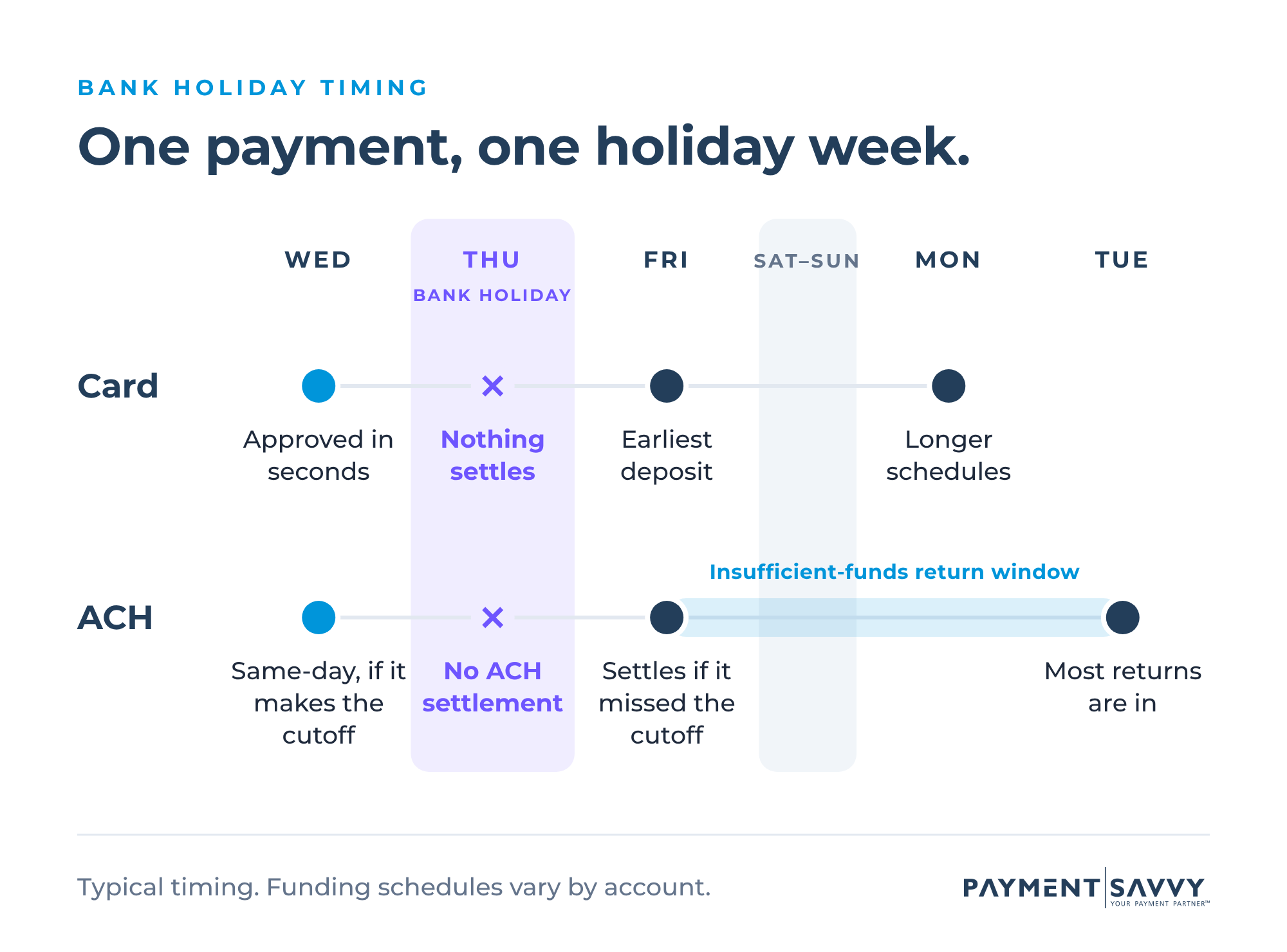
Say the card payment makes Wednesday’s batch cutoff. Thursday is Thanksgiving, so nothing settles and the agency’s funding schedule shifts. Depending on the processor and the account, the deposit arrives Friday, Monday, or later. A holiday followed by a weekend can turn a short funding delay into several days without a deposit.
On the ACH side, Wednesday’s cutoff decides the timing. A payment that goes in before the same-day cutoff can settle Wednesday. A payment that misses it waits for Friday, the next banking day.
ACH also has a second wait, because a payment can settle and still come back. For insufficient funds, the return window generally runs through the second banking day after settlement. A Friday settlement keeps that window open through Tuesday, since the weekend doesn’t count. Other return reasons, including some unauthorized consumer payments, have longer windows. So the agency might see the payment recorded Wednesday, settled Friday, and returned early the next week. When that shows up in its software depends on the account setup.
None of this means anything went wrong. The payment worked exactly as designed, just on a longer calendar.
The 11 Federal Reserve bank holidays
The Federal Reserve observes 11 holidays a year. Instead of listing one year’s dates, here are the rules behind the Federal Reserve’s published holiday schedule.
Five fall on the same date every year. They are New Year’s Day on Jan. 1, Juneteenth on June 19, Independence Day on July 4, Veterans Day on Nov. 11, and Christmas Day on Dec. 25.
Five more fall on Mondays. Martin Luther King Jr. Day is the third Monday in January, and Washington’s Birthday, commonly called Presidents Day, is the third Monday in February. Memorial Day is the last Monday in May, Labor Day is the first Monday in September, and Columbus Day is the second Monday in October. Thanksgiving is the only Thursday holiday, on the fourth Thursday in November.
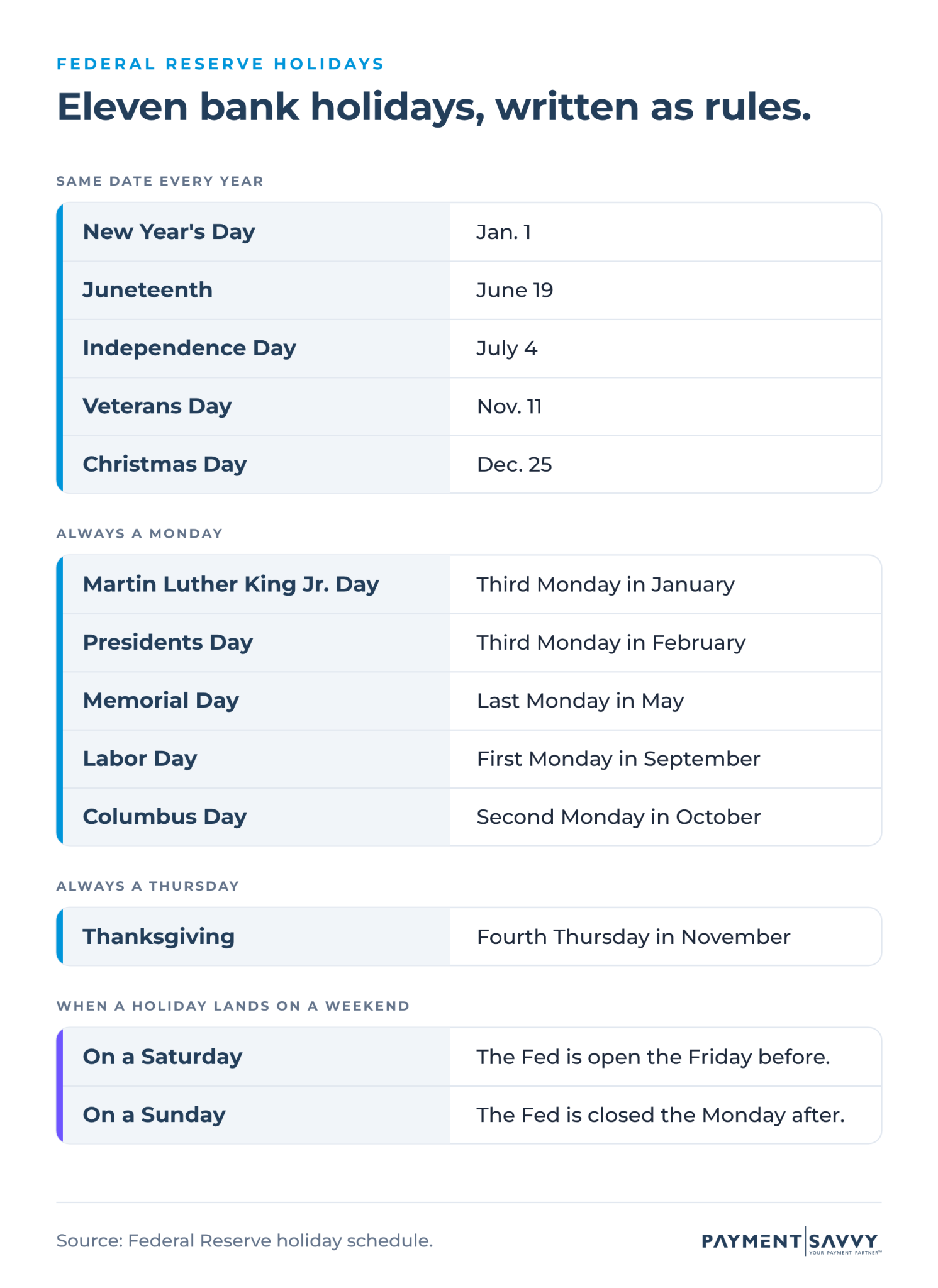
Weekends add a wrinkle. When a fixed-date holiday falls on a Sunday, Federal Reserve Banks close the following Monday. When it falls on a Saturday, they stay open the Friday before. Other federal offices, commercial banks, and payment providers don’t always follow that rule, though. A Friday that looks like a holiday on one calendar can still be a Federal Reserve banking day. On that Friday, ACH payments can settle while a bank following its own holiday calendar holds card funding until Monday.
Two holidays catch agencies off guard. Columbus Day and Veterans Day close the Fed, but many businesses stay open and consumers keep paying. Meanwhile, ACH settlement and bank funding pause for the day. The reverse happens around Thanksgiving and Christmas. The Friday after Thanksgiving and Christmas Eve aren’t Federal Reserve holidays. Even so, some banks and processors shorten their hours or move cutoffs earlier.
When a bank holiday lands near month-end
Bank holiday timing stands out most when the payment date and the deposit date fall in different months. Take the card payments an agency accepts on Dec. 31. With New Year’s Day the next morning, those payments will typically reach the bank in January. A holiday that runs into a weekend stretches the gap further.
The agency’s collections software shows a December payment, while the bank statement shows a January deposit. Reports built on payment dates and on deposits will show different totals, and both are accurate.
That’s worth knowing when your team reconciles daily deposits or prepares client remittance and month-end reports. Knowing whether a report reflects payment activity, settlement, or bank funding explains the difference before it turns into a long investigation. The same goes for Thanksgiving, Christmas, and any holiday near an agency’s reporting cutoff.
How Payment Savvy handles holiday weeks
At Payment Savvy, we monitor our banking partners’ published holiday schedules and help customers understand how those schedules affect their funding. Funding arrangements vary by account, so the most useful answer comes from your agency’s actual setup. Your Payment Savvy account manager can walk through the funding schedule that applies to your account.
A quick check before the next holiday
Pull up one holiday week from last year. Compare the payment dates in your collections software with the dates the deposits reached your bank account, and keep card and ACH separate. Look closely at payments made after the daily cutoff and at deposits that crossed into the next month. The pattern you find is your account’s usual holiday rhythm. It’s a better guide than any general rule, including the ones in this post.
Payment Savvy has focused on payment processing for collection agencies since 2011. To see how we work with agencies, visit our page on payment processing for collection agencies.
A completed payment is the finish line. With the holiday calendar in hand, your team can see the deposit coming before anyone has to ask.
PAYMENT SOLUTIONS
FEATURED INDUSTRIES