Can We Keep Our Software? Payment Integrations for Collection Agencies

TABLE OF CONTENTS
“Can we keep working with our software and the vendors we already trust?”
I’ve heard some version of that question from collection agency owners for more than 20 years. It comes up at booths, over dinner, and early in almost every first conversation about payment integrations. It’s a fair question. Every agency deserves a clear answer to it from its payment partner.
I understand why it matters so much. An agency’s collection software is where the work lives. Account notes, payment history, payment plans and client reporting all sit there. Around that system, most agencies have also built a group of vendors they picked on purpose, for things like letters and calling. Those choices took time, and the team knows how to use them.
So when an agency asks whether a new payment partner fits into that picture, it isn’t asking for a sales answer. It wants to know what changes for the people doing the work.
What “agnostic” means, and the question that comes next
You hear the word “agnostic” a lot in payments. Usually it means a provider can work with many different systems. That’s a good start. For an agency, though, the next question matters just as much: what happens when the connection you need isn’t there yet?
Sometimes the connection already exists, and the conversation moves quickly. Other times it doesn’t exist yet, and that’s where you learn what a payment partner means by “agnostic.” Some providers will show you the systems they support today and stop there. A partner worth your time will want to understand your whole setup first. That means your software, the vendors around it, and how your team uses them. From there, the job is finding the easiest way to fit in.
There’s another version of this question, too. Some software comes with a payment option built in, and for plenty of agencies it’s a good fit. When it isn’t, an agency should still know it has choices. Your software is where your team works every day. Your payments deserve the same kind of fit, and you shouldn’t have to give up one to get the other.
When I sit down with an agency, I start with a few simple questions. Which software do you run? Which vendors touch an account before or after a payment? What does your team need to see when a payment posts? The answers tell me more than any feature list. They show me how the agency actually works, and that’s what any connection has to support.
The work behind a payment integration
I’ll be straight about something. A payment integration takes real work on both sides.
Connecting a payment platform to collection software is more than flipping a switch. First, both technical teams have to agree on how a payment moves from one system to the other. A payment taken by phone or online has to post to the right account for the right amount. It also has to show up the way your staff expects to see it. Payment plans need to run on schedule. Returns and reversals need somewhere to land. Then everyone tests it, finds the odd cases, and tests it again.
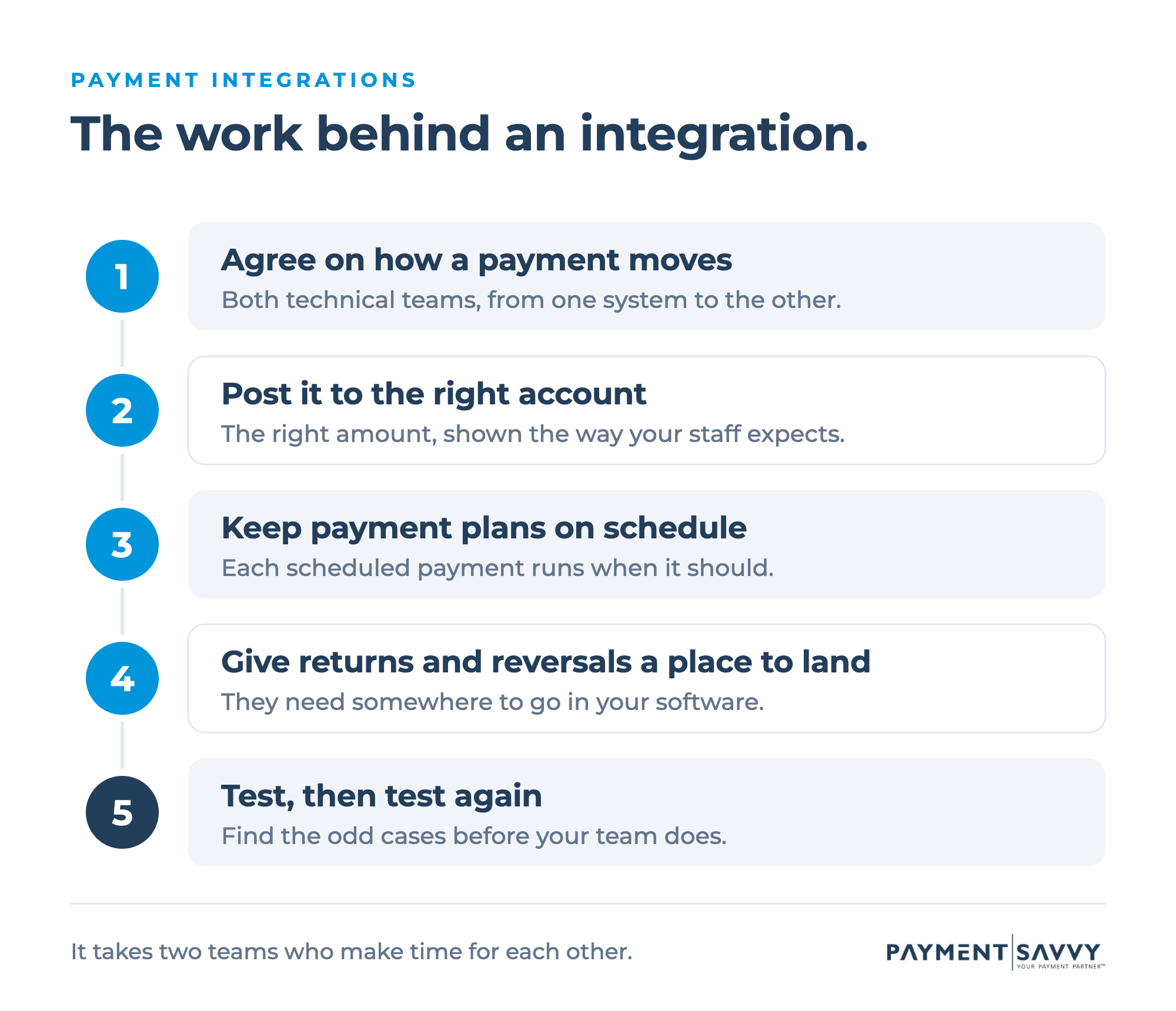
None of that happens on one company’s timeline alone. The software provider has its own roadmap and its own customers to serve. Good integrations come from two teams who make time for each other.
That’s why I’d rather tell an agency “not yet, and here’s what it would take” than say “sure” and figure it out later. A vague yes feels good in a first meeting. It feels a lot worse three months into an implementation.
At Payment Savvy, we have an integration specialist on staff who works through exactly these details. Sometimes an agency brings us a system we don’t connect to yet. We look at it together and work out the best way in, and the agency gets a straight answer about what that takes.
Keeping the vendors you trust
Being open to other vendors should mean something in practice. For us, it means the agency’s choices stay at the center of the conversation.
Here’s one example. When agencies move to Payment Savvy, some keep their existing payment gateway and some move to a new one. We’ve seen both, and we handle both. The agency’s setup decides which way it goes.
The same thinking applies to everything around the payment. I know how much those vendor relationships matter, because relationships are how Payment Savvy has grown over 15 years. So if your agency has worked with the same letter vendor for ten years, we’re not trying to compete with that. We’d like to earn that same kind of trust, and find our place alongside the partners you already have.
Integrations run on relationships
People often talk about payment integrations as if they were only code. In my experience, they run on relationships just as much.
Over my career, the integrations I’ve seen go best started with people who already knew each other. Someone picks up the phone. Someone remembers the agency that needed a fix last spring. Someone on the software side trusts that the payment side will do its part. You can’t write that into an API.
That’s a big part of how we work at Payment Savvy. An agency may need something that isn’t on a list yet. When that happens, we’re willing to go the extra mile to find out what it would take. It might be one phone call. It might be a few rounds of testing and back and forth until the connection does what your team needs.
What a clear answer on payment integrations looks like
If you’re talking with a payment partner about integrations, two questions get to the heart of it quickly. Which of our systems do you connect with today? And if one isn’t there yet, what would it take?
The right partner answers both plainly, including the parts that take time. Agencies deserve to understand what’s available today, and to have a partner willing to explore what comes next.
To see how we work with agencies and the systems they rely on, visit our page on payment processing for collection agencies.
A completed payment is the finish line. How your agency gets there, and with which vendors, should stay your call.
PAYMENT SOLUTIONS
FEATURED INDUSTRIES